Ticino cross-border workers: 2026 tax under new agreement

The short answer
It depends on when you started. If you worked in Ticino as a cross-border worker at any point between 31 December 2018 and 17 July 2023, you are an old cross-border worker and pay tax in Switzerland only. If you started later, you are a new cross-border worker: Ticino withholds 80% of the normal tax at source, and Italy taxes your salary above €10,000, taking off part of what you already paid in Switzerland.
Put like that, it sounds like a technical detail. On your payslip it isn't. With Ticino's 2026 tax tables and Italy's 2026 income tax brackets, a single person earning CHF 5,500 gross over 13 monthly payments pays about €7,790 in tax a year as an old cross-border worker and about €19,790 as a new one. Below we show where these figures come from, who falls into which group, what changes with working from home and the 25% substitute tax, and what is moving for 2027.
Old or new cross-border worker: one date decides
The Agreement between Switzerland and Italy of 23 December 2020 has been in force since 17 July 2023 and applies from 1 January 2024. It replaced the 1974 agreement, which never even said who counted as a cross-border worker (frontaliere). Now there is a definition, and it applies to everyone: you are a cross-border worker if you live in a municipality that lies, even partly, within 20 km of the border, you work as an employee in the canton of Ticino, Graubünden or Valais, and you go home, as a rule, every day.
The "municipality within 20 km" isn't measured with a ruler. What counts is an official list agreed by the two countries, List 1. There is also an older list, List 1A, from the 1974 agreement. According to Ticino's tax division (Divisione delle contribuzioni), List 1 contains about 70 more Italian municipalities. As we'll see, that gap created a group of its own.
The "daily return" has some slack. The Additional Protocol lets you stay away from home for work for up to 45 days per calendar year, not counting holidays and sick leave. The canton's information sheet puts it in practical terms: about one day a week if you work full time. Go over that limit and you lose the status for that year.
To be an old cross-border worker, it's enough to have worked as a cross-border worker for tax purposes in one of the three cantons, even briefly, at any time between 31 December 2018 and 17 July 2023. There's no minimum period. Your employer must, however, have paid tax at source for that period, and you must have been living in a List 1A municipality at the time. Nationality doesn't matter, and a G permit alone isn't enough: for tax purposes a cross-border worker is anyone who meets the Agreement's conditions, including a Swiss citizen living in Italy.
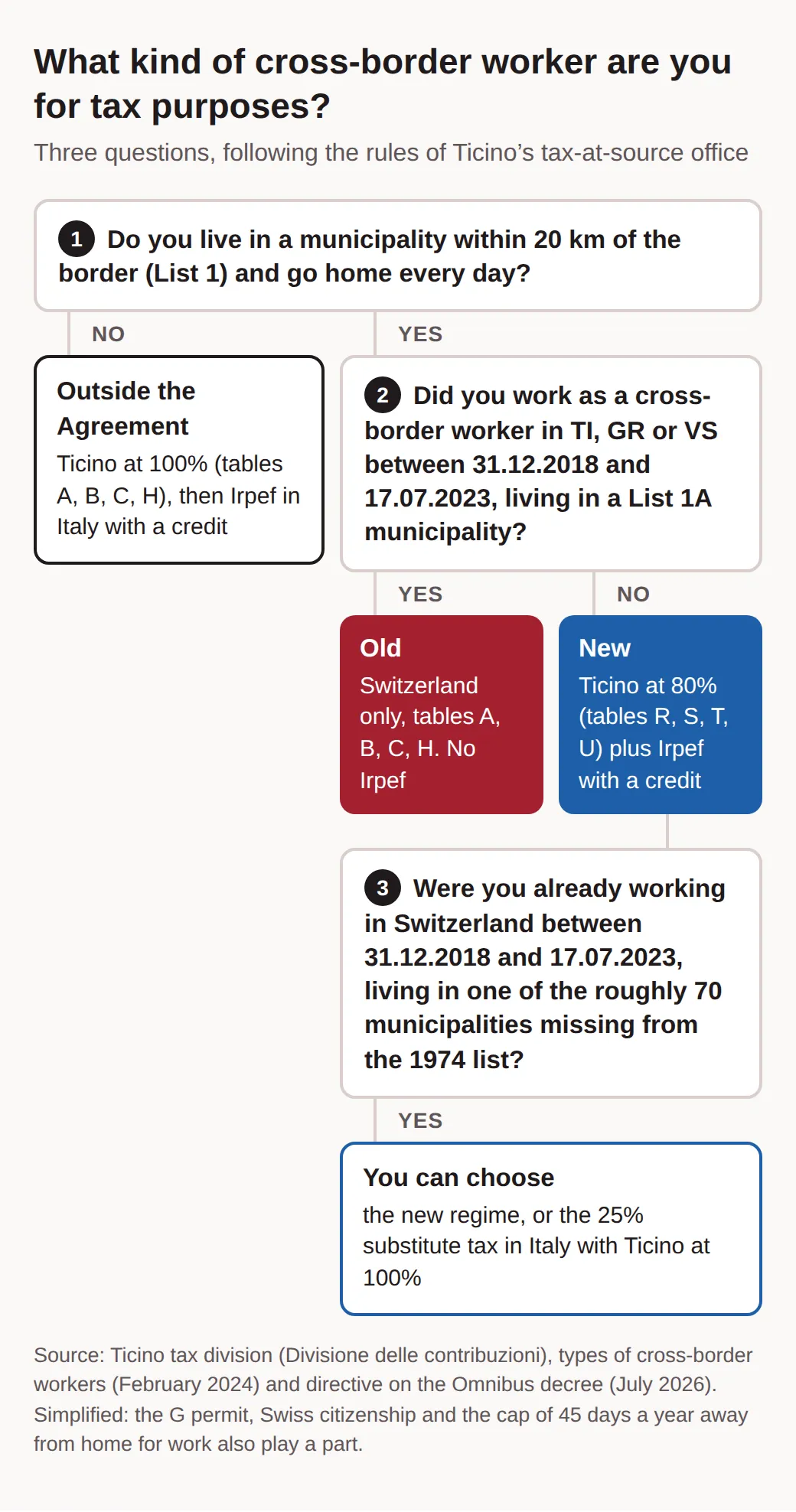
If you live further away, or only go home at weekends, you are outside the Agreement. In that case Ticino applies the full tax at source and Italy taxes the same salary with a credit for the Swiss tax, as the canton's paper on the types of cross-border workers explains. For everyone else, the first bill comes from Ticino.
What Ticino withholds in 2026
Your employer deducts tax at source every month. For old cross-border workers it uses the ordinary tables A, B, C and H. For new ones it uses tables R, S, T and U, which are set at 80% of the ordinary ones: that's the rule in Article 3 of the Agreement, which caps Swiss tax at 80% of the federal, cantonal and municipal tax. The letter reflects your family situation: A and R for single people, B and S for a married person whose spouse has no income, C and T when both spouses work, H and U for single parents living with dependent children. The number after the letter is the number of children.
Ticino sets the rate on an annual basis. The cantonal directive on tax at source gives an example: someone earning CHF 5,000 a month plus a 13th-month salary has a rate-determining income of CHF 65,000, and the rate found for that income applies to every monthly payment. We took the 2026 rates from the official file of tax-at-source rates published by the Federal Tax Administration. For a salary of CHF 5,500 over 13 payments, so CHF 71,500 a year, these are the results:
| Situation | Old cross-border worker | New cross-border worker |
|---|---|---|
| Single, no children | A0: 10.1% | R0: 8.0% |
| Married, spouse with no income | B0: 5.2% | S0: 4.1% |
| Married, both earning, 2 children | C2: 5.9% | T2: 4.7% |
| Single parent, 1 child | H1: 3.8% | U1: 3.0% |
For the single person, that's CHF 555.50 a month as an old cross-border worker and CHF 440 as a new one. So the new cross-border worker has less withheld in Switzerland. The catch is that the bill doesn't end there, and you can't ask for a subsequent ordinary assessment in Switzerland to claim expenses and deductions either: the canton's information sheet points out that the two countries ruled it out. The rest is settled in Italy.
What a new cross-border worker pays in Italy
A new cross-border worker declares the Swiss salary in Italy, but not all of it. Circular 25/E of the Italian Revenue Agency confirms that from 2024 the first €10,000 of a cross-border worker's income is exempt from Irpef, Italy's personal income tax. The 2023 ratification law raised this allowance from €7,500. The same law made Swiss family allowances non-taxable and contributions to industry early-retirement schemes deductible. The instructions for the 2026 Form 730 ask you to enter the full income with code 4, and only the part above €10,000 goes into the calculation.
The social security contributions deducted in Switzerland reduce the base too. This is the formula that Italian and Swiss cross-border workers' unions, from CGIL to OCST, give in their guide to the new agreement: gross salary minus the allowance, family allowances, and the contributions for old-age and disability insurance, income compensation, unemployment, pension fund and accident insurance (AVS, AI, IPG, AD, LPP and LAINF on a Ticino payslip). The 2026 Irpef brackets then apply to what's left, as adjusted by Italy's 2026 budget law: 23% up to €28,000, 33% up to €50,000, 43% above that.
Then comes the credit for the Swiss tax, with a trap that some online calculators ignore. Under Article 165(10) of Italy's income tax code, cited in that same Circular 25/E, the credit is reduced in the same proportion as the foreign income that ended up in the Italian taxable base. In practice the allowance also takes a slice off the credit: if 86% of your income is taxed in Italy, you can deduct 86% of the Swiss tax, not all of it.
The calculation step by step
Take the single person on CHF 5,500 over 13 payments. To convert, we use the ECB reference rate of 16 October 2026, CHF 0.9272 to the euro. Of the contributions, we only count those that are the same for everyone: 5.3% for old-age, survivors' and disability insurance and income compensation (AVS, AI and IPG), according to leaflet 2.01, and 1.1% for unemployment insurance, according to leaflet 2.08. Pension fund and accident insurance contributions vary from employer to employer and are left out.
- Annual salary: CHF 71,500, or €77,114.
- Minus old-age, disability, income compensation and unemployment contributions of 6.4%: €72,179.
- Minus the €10,000 allowance: taxable income of €62,179.
- Gross Irpef: €6,440 on the first 28,000, €7,260 on the next 22,000 and €5,237 on the rest, €18,937 in total. Above €50,000 the tax credit for employment income is zero.
- Swiss tax: CHF 5,720, or €6,169. The deductible part is the share taxed in Italy, 62,179 out of 72,179: €5,314.
- Irpef to pay: 18,937 minus 5,314, or €13,622.
That adds up to about €19,790 in tax a year, against €7,790 for an old cross-border colleague on the same salary. Our calculation leaves out the regional and municipal surcharges, which depend on where you live, and personal deductions such as medical costs or mortgage interest, which a new cross-border worker can claim in Italy. Everyone's real bill differs, but the order of magnitude holds, and it shows clearly when you compare several salaries.
Three regimes compared
We ran the same calculation for three typical salaries in Ticino, again for a single person with no children. The chart lines up three cases: the old cross-border worker, the new cross-border worker, and the new cross-border worker who opts for the 25% substitute tax, which we cover in the next section.
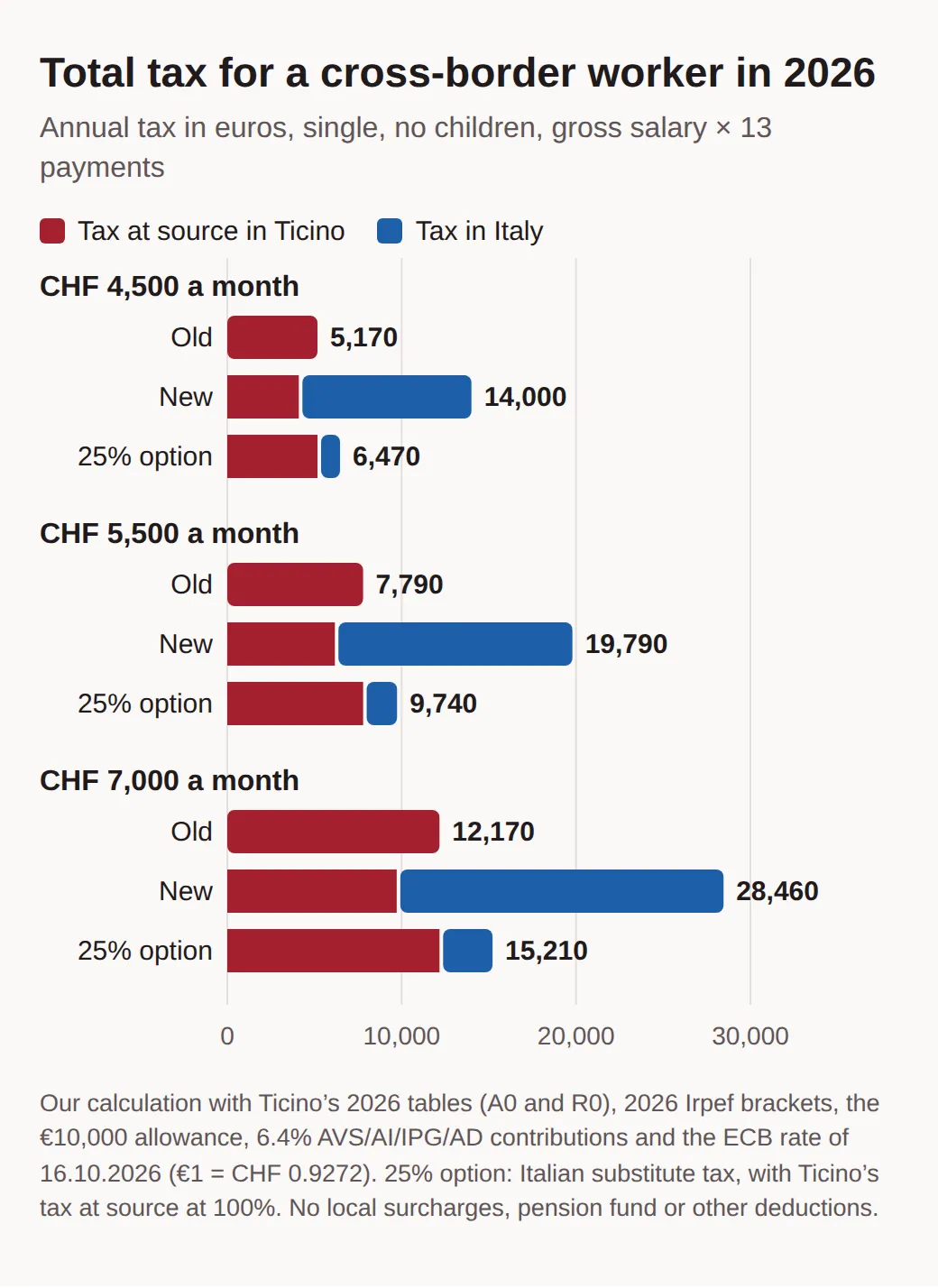
The red part of the new cross-border worker's bar is always the shortest: in Switzerland they pay less than anyone. But the Irpef they owe is roughly two to almost two and a half times what Ticino withholds, because the credit only covers part of the Italian tax. The upshot is that, on the same salary, a new cross-border worker pays 2.3 to 2.7 times as much tax as an old one. On CHF 5,500 a month the difference is about €12,000 a year, about €1,000 a month.
So if you're comparing a job offer in Ticino with one in Italy, start from the real net pay, not the gross figure in francs. And find out which group you fall into before you sign, because for new cross-border workers the Irpef arrives a year later, with the tax return, and never shows on the payslip.
The 25% substitute tax and the July 2026 directive
One group got stuck in the middle: people who were already working in Switzerland between 31 December 2018 and 17 July 2023 but lived in one of the roughly 70 municipalities that only appear on List 1. Under the 1974 agreement they weren't cross-border workers for tax purposes, so they can't be old cross-border workers. Decree-Law 113 of 2024, known as the Omnibus decree, gave a choice to people living in the municipalities listed in its annex. As the Italian Revenue Agency's page on cross-border commuters explains, they can pay a substitute tax in Italy equal to 25% of their Swiss tax, instead of Irpef and the local surcharges. Anyone who chooses it can no longer deduct the Swiss tax and still owes the health service contribution set by the 2024 budget law, but can take 20% of that contribution off the substitute tax.
The idea was simple: 80% in Switzerland plus a quarter of that amount in Italy makes 100%, the same burden as an old cross-border worker. Ticino, however, has moved the goalposts. In its July 2026 directive, which applies from 1 January 2024, the tax division argues that anyone who opts for the substitute tax leaves the double taxation convention, and with it the Agreement. For these people the employer must use the full tables A, B, C and H, no longer R, S, T and U.
Here's how that changes the bill. On CHF 5,500 a month, Ticino withholds CHF 7,221.50 instead of CHF 5,720, and the Italian substitute tax rises to CHF 1,805: about €9,740 in total, a quarter more than an old cross-border worker. That is still far less than the €19,790 under the ordinary regime, as the chart shows.
If you don't choose the substitute tax and the full tables are applied to you anyway, you can claim back 20% of the tax withheld, so that you pay as you would under tables R, S, T and U. The directive sets the deadline at 31 March of the following year and asks for proof of ordinary taxation in Italy; a copy of your Italian tax return is enough to show you didn't choose the substitute tax. The canton also announces spot checks. On the Italian side, the new consolidated income tax code, Legislative Decree 117 of 2026, repeals the Omnibus article and gives cross-border workers a chapter of their own, Articles 217 to 221: check whether the rule changes before you file your 2027 return.
Working from home: the 25% that doesn't change your status
Since 9 February 2026 a protocol has been in force that sets permanent rules for cross-border workers working from home, with effect from 1 January 2024. The Federal Tax Administration's press release sums it up in one sentence.
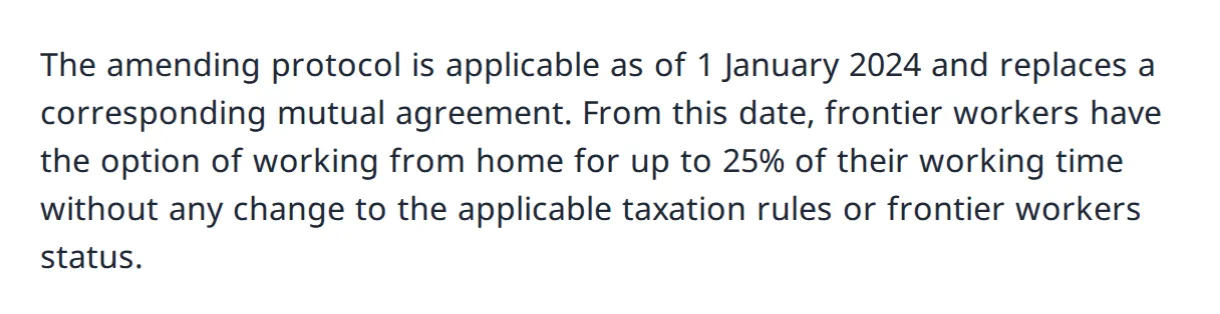
The text of the protocol adds three useful details. The 25% is counted over the calendar year, not the week. It applies to all cross-border workers, old ones included. And days worked from home within that limit count, for tax purposes, as days worked in Switzerland: your salary is taxed as before.
The protocol doesn't say what happens above 25%. If your contract allows more working from home, ask the tax-at-source office (Ufficio delle imposte alla fonte) before you sign it. The protocol only covers tax: for social security contributions, put the same question to the compensation office.
Changing jobs without losing your status
If you're looking for a new job, this is the rule that matters most. Point 11 of the Additional Protocol says that an old cross-border worker stays taxed in Switzerland only, even after ending a job or changing employer, as long as they still meet the Agreement's conditions and work in the border area for a Swiss employer. The status follows the person, not the contract.
Your new employer does need to know about it, though. For anyone hired from 18 July 2023 onwards there is Form 1A, the certificate of old cross-border worker status, which the employer fills in and you countersign. On the canton's page on the Agreement you'll find the form, an online request for the certificate and a simulator to check your status. If your new employer applies an R table by mistake, you are treated as a new cross-border worker, including in the data Switzerland sends to Italy every year: check your first payslip.
Watch out when you move house too. The canton's information sheet says that if you leave the 20 km zone and come back years later, you remain an old cross-border worker. The Omnibus directive, however, refers to other rules for people moving from a List 1A municipality to one of the newly added ones. Before you move, asking the tax-at-source office first is cheaper than getting it wrong.
What changes in 2027 and what is still open
The most concrete change concerns the families of new cross-border workers. On 15 September 2026 Ticino's Grand Council, the cantonal parliament, approved the proposal to restrict the child deduction for cantonal and municipal tax to people living in Switzerland. According to the cantonal government's dispatch on the 2027 budget, anyone living in a country that uses the credit method, such as new cross-border workers, will no longer get the deduction in Switzerland, because their family situation can be taken into account in Italy. It is due to take effect on 1 January 2027. The rates for new cross-border workers with children, such as T2 and U1 in our table, are therefore set to rise. The canton's 2027 tables will show by how much.
The so-called health tax for old cross-border workers is still unresolved: the health service contribution that Italy's 2024 budget law (Law 213 of 2023) allows the border regions to charge. In a press release of 30 June 2026, Ticino's Council of State, the cantonal government, called it a tax that breaches the agreements and suspended, as a precaution, CHF 50,221,177 in compensation payments (ristorni) due to Lombardy, half of its share. The same press release reports that Lombardy has asked Rome to postpone the levy to 2027. The canton stresses that suspending the ristorni does not affect workers.
Before you sign a contract in Ticino
For a job in Lugano, Mendrisio or Bellinzona, the first step is to work out which group you fall into. Use the canton's simulator, get the certificate if you're an old cross-border worker and hand it to your new employer. If you're a new cross-border worker, redo the calculation above with your own salary and set aside every month the Irpef you'll pay with the following year's tax return: on CHF 5,500 gross, that's over €1,100 a month. The first return usually brings advance payments for the current year as well.
Then read the contract the way the tax office would: how many days of working from home it allows, how many nights away on business trips, and which table appears on the first payslip. Those are the three places where a status gets lost without anyone noticing. Keep an eye on them and you'll know, before you say yes, how much you'll really take home.
Common questions
- Can a part-time worker be a cross-border worker for tax purposes?
- Yes. The canton confirms that only the Agreement's definition counts: a municipality within 20 km, employment in Ticino, Graubünden or Valais and a daily return home. Your employment percentage makes no difference. For a new cross-border worker on part-time hours the Italian allowance stays at €10,000, so it covers a bigger share of a small salary.
- Can a Swiss citizen living in Italy be a cross-border worker?
- Yes, if they meet the same conditions. The tax authorities do not look at your passport: what counts is your tax residence, your municipality and the daily return home. The transitional regime for old cross-border workers does not depend on nationality either.
- Do I have to declare Swiss family allowances in Italy?
- They are not taxed in Italy. The Italian law ratifying the Agreement in 2023 made the family allowances that Swiss social security funds pay to cross-border workers exempt from Irpef. This applies to old and new cross-border workers alike.
- Can a new cross-border worker ask for a subsequent ordinary assessment in Switzerland?
- No. When they signed the Agreement, Italy and Switzerland ruled this out for cross-border workers under it: tax at source is the only method in Switzerland. Personal expenses and other deductions are claimed on the Italian tax return instead.