G permit in Ticino: requirements, renewal and changing jobs

The short answer
The G permit is the cross-border commuter permit: you need it if you work in Ticino but keep your home abroad. You apply to the cantonal Migration Office before your first day of work, and since 3 August 2026 only online. For EU/EFTA nationals it costs CHF 75, lasts five years with a contract of at least one year, and requires you to go home at least once a week.
So far, these are the answers you'll find everywhere. The details that make the difference, though, sit in a handful of pages from the canton's Population Section (Sezione della popolazione) and in two agreements between states, and many guides online never get that far. We read them in full, starting with the simplest question: who is entitled to the permit.
Who can get a G permit
For a national of the European Union or EFTA there are three conditions: you live in an EU/EFTA state, you work in Switzerland, and you go home every day or at least once a week. They are set out in Article 7 of Annex I to the Agreement on the Free Movement of Persons (official text in Italian). What counts is your contract with an employer in Switzerland, not the municipality you live in.
For EU/EFTA nationals, border zones no longer exist. The State Secretariat for Migration (SEM) puts it in one line: "No border zones exist for them anymore." An EU/EFTA cross-border commuter can therefore live anywhere in the EU or EFTA and work anywhere in Switzerland. An engineer who lives in Bergamo and works in Lugano has the same right to a G permit as a cashier from Como.
For third-country nationals the rules are tighter. The Foreign Nationals and Integration Act (in Italian) requires two things: a permanent right of residence in a neighbouring state, having lived in the border zone for at least six months, and a job in Switzerland within the border zone. Ticino issues them a permit valid only in the canton and runs a labour market test on these applications, with a fee of its own. The table sums up the differences that matter most in practice.
| Rule | EU/EFTA nationals | Third-country nationals |
|---|---|---|
| Where the permit is valid | All of Switzerland | Canton of Ticino only |
| Where you can live | Anywhere in the EU/EFTA | Within 20 km of the border |
| Changing employer | Report it beforehand | New authorisation needed |
| ID for the application | ID card valid for travel abroad, or passport | Passport |
Short jobs: sometimes a notification is enough
An EU/EFTA national who works in Switzerland for no more than three months per calendar year doesn't need a G permit. According to the State Secretariat for Migration, this kind of work only requires an online notification. Beyond three months and under a year you need the permit, which then lasts as long as the contract.
If you take a ten-week seasonal job and haven't already worked in Switzerland that year, the notification is all it takes. If you sign for four months, you have to apply for the permit. Once you know whether you need a permit at all, the next question is where you are allowed to live.
Where you can live with a G permit
For the G permit, an EU/EFTA national can live in any municipality in the EU or EFTA. For tax purposes, though, if you live in Italy, what counts is the municipality you live in. These are two different rules, written in two different agreements, and mixing them up can be expensive.
The tax agreement between Switzerland and Italy (in Italian), in Article 2, treats as a cross-border commuter only someone who is tax resident in a municipality lying wholly or partly within 20 km of the border, works as an employee in Ticino, Graubünden or Valais, and in principle goes home every day. The G permit is not one of the conditions. If you live in Milan and work in Lugano, your G permit is valid, but for tax purposes you are not a cross-border commuter: your taxes follow other rules, which we explain in our article on cross-border commuter taxes under the new agreement.
For third-country nationals, distance matters for the permit too. Ticino's notes for third-country nationals (in Italian) state that the permit lapses if the holder moves their home abroad outside the 20 km border strip. A move from Varese to Bologna costs them the permit.
One obligation applies to everyone: you must report a new address abroad to the Migration Office within 14 days. That has a cost too, which we come to below. First, though, a rule that is easy to misread: going home.
The weekly return: what the law actually requires
The G permit requires you to go home abroad at least once a week. If you do, you can spend the other nights in Ticino. The Migration Office's notes for EU/EFTA nationals (Ufficio della migrazione, updated September 2024, in Italian) put it like this: the permit entitles you to stay overnight in any Swiss municipality, but you must leave the country at least once a week and register your presence with the residents' registration office of the municipality where you sleep.
In practice: if you spend Monday to Thursday nights in a studio flat in Bellinzona and go back to Sondrio on Friday, you are within the rules of the permit, provided you have registered with the municipality of Bellinzona. If you don't register, you risk a fine. For third-country nationals the stakes are higher: their notes cite failing to go home every week as an example of unlawful residence, which is a reason to revoke the permit.
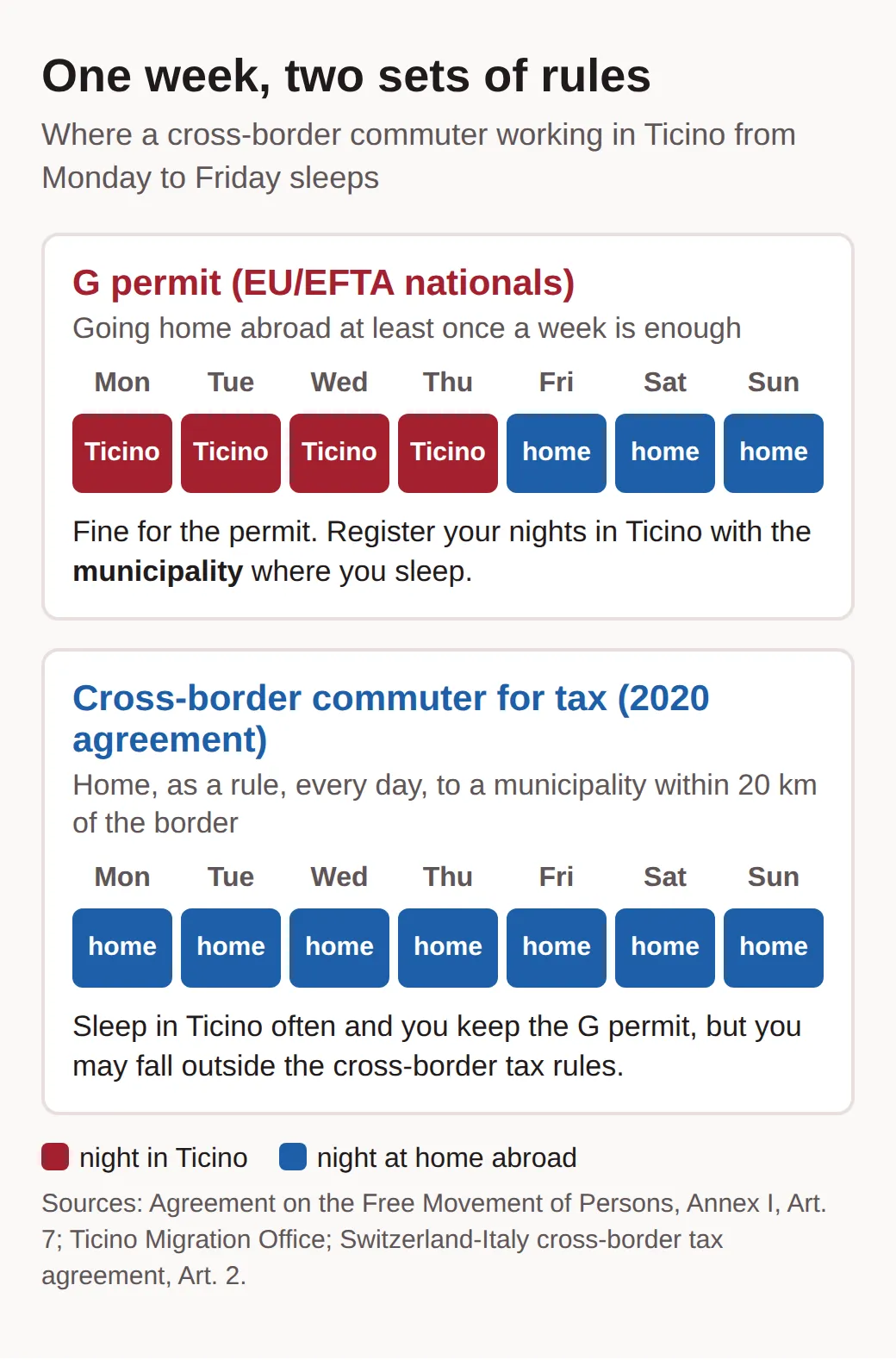
The tax authorities, as we saw, look for a daily return. If you often sleep in Ticino you keep your G permit, but you can lose your tax status as a cross-border commuter, and the taxes are very different. Before you rent a room near work, it pays to check both sets of rules, not just one. The next step is the application.
How to apply for a G permit: online only since 3 August 2026
Since Monday 3 August 2026, permit applications can only be filed through the new digital procedure, as the Population Section's news page (in Italian) announced. You fill in the form online, upload your documents digitally and no longer send them by post as well. At the end you get a receipt or a substitute declaration confirming that your application was sent.
Before the form, though, there is a step in person. The canton's page for a new G permit (in Italian) says that if you work for an employer based in Ticino, you must go to a cantonal police station (Gendarmeria) to have your identity document checked. Five stations are listed: Camorino, Caslano, Locarno, Mendrisio and Noranco. The copy of the document certified by the police goes with your application.
The form itself lists what to have ready.
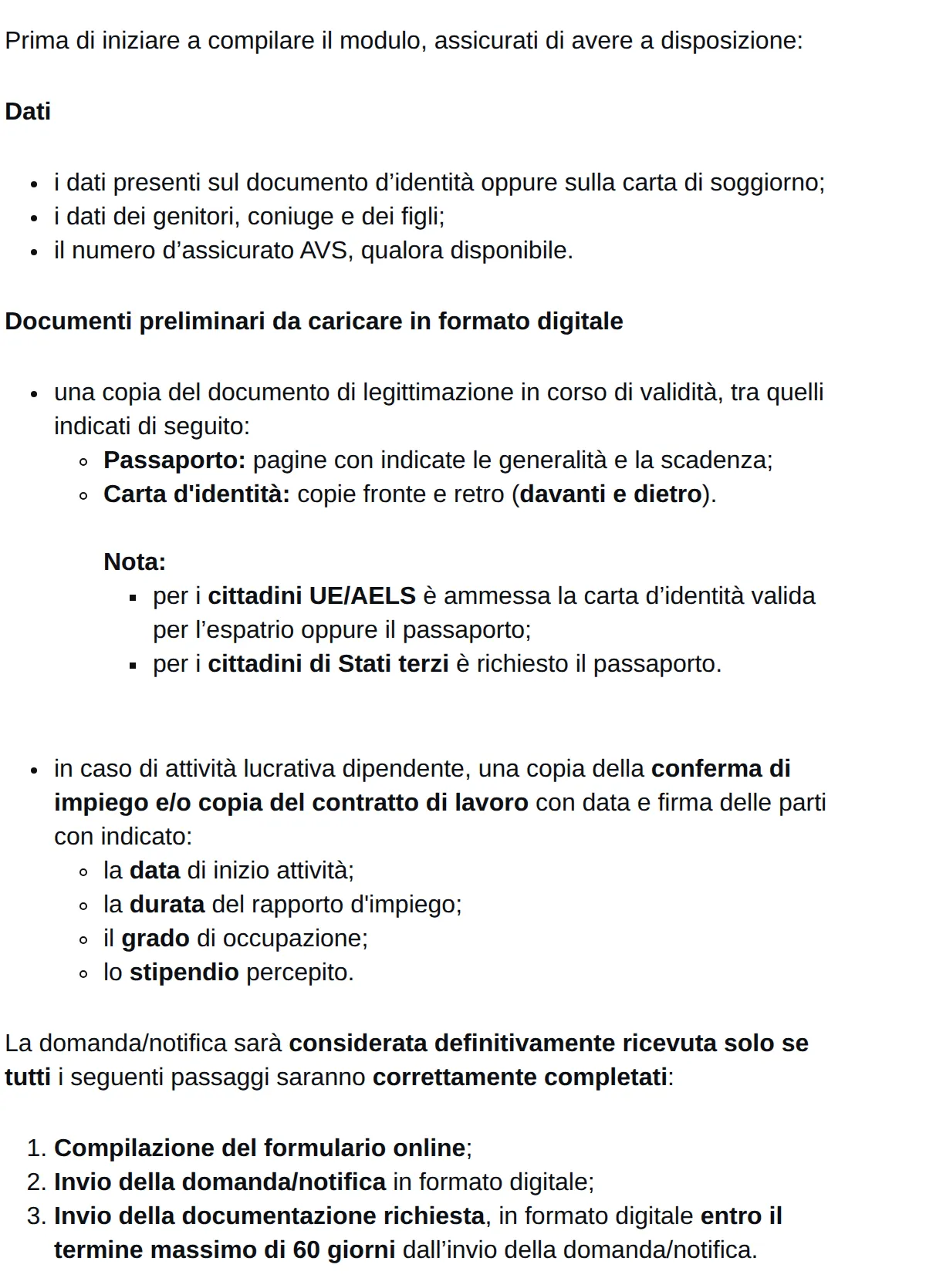
Two details deserve attention. The contract must state four things: the start date, the duration, the workload (the percentage you work) and the salary. An offer by email without these details is not enough. And your application only counts as received once all the documents have been uploaded, at the latest 60 days after you submit it.
For Italian citizens there is one more deadline worth taking seriously. Ticino points out that since 3 August 2026 the old paper Italian identity card is no longer valid for travel abroad, whatever expiry date is printed on it. For EU/EFTA nationals the form accepts only an ID card valid for travel abroad or a passport: if you still have the paper card, ask the Italian authorities to replace it in good time, before you start the application.
Once you have applied, you are invited to have your biometric data taken, meaning the photo and signature for the permit card. Since 9 December 2025 Ticino sends this invitation by email to the address given in the application, with a link to move the appointment and a reminder three days before. The form itself advises you to check your spam folder too.
Your employer has a task as well. The notes remind employers that anyone employing foreign staff not resident in Switzerland must register with the cantonal withholding tax office (Ufficio delle imposte alla fonte) within 8 days of hiring them. It isn't your responsibility, but a new employer with little experience of cross-border commuters may not know.
How much a G permit costs
For an adult EU/EFTA national, issuing the permit costs CHF 75, and so does renewing it. The fees are published on the G permit renewal page (in Italian), together with those for third-country nationals, who pay more in almost every case.
| Procedure | EU/EFTA, adults | Third countries |
|---|---|---|
| Issue | CHF 75 | CHF 110 |
| Renewal | CHF 75 | CHF 90 |
| Change of job | CHF 60 | CHF 110 |
| New address abroad | CHF 40 | CHF 55 |
| Duplicate | CHF 60 | CHF 55 |
For EU/EFTA nationals, CHF 15 may be added when a new photo and signature are needed, and CHF 10 to print a new card after a change of address or marital status. Minors pay CHF 40 for almost every procedure and CHF 30 for a new address. Third-country nationals also pay the labour market test fee: CHF 150 for a new permit, CHF 100 for a renewal and CHF 150 if the application is refused.
Finally, there is one cost you can avoid: when an application is left incomplete, the registered reminder letter costs CHF 20. A complete application the first time saves you that. Once paid for, the permit lasts a long time, but not for ever.
How long a G permit lasts and how to renew it
With a permanent contract or one lasting at least a year, the EU/EFTA G permit is valid for five years. With a shorter contract, between three months and a year, it lasts as long as the contract. This is confirmed by Annex I to the Agreement on the Free Movement of Persons and by the State Secretariat for Migration's page. The agreement adds that the card is renewed for at least another five years, as long as the cross-border commuter shows that they are working.
It is you, not your employer, who applies for the renewal, at least 14 days before the permit expires and through the online procedure. The canton's notes are clear on this point. If you forget and let the permit expire, you can no longer renew it: you have to file a new application, as you did the first time. The same applies if you have stopped working for more than six months.
For third-country nationals the permit is limited in time and can be extended. After five years of uninterrupted work, the Foreign Nationals and Integration Act (in Italian) gives a right to an extension, provided there are no grounds for revoking it. Five years is a long time, and the expiry date comes round when nobody is thinking about it any more. Before the renewal, though, something else often happens: a change of job.
Changing employer with a G permit
As an EU/EFTA cross-border commuter you can change employer without asking anyone's permission. Ticino's notes speak of a right to change jobs with a valid permit within six months of the end of your previous job, without waiting for an authorisation. All you need to do is report it to the Migration Office before you start the new job. Reporting a change of job costs CHF 60.
The order of the steps matters. The end of your previous job must be reported within 14 days, as the page on the end of employment (in Italian) requires; you, your employer or both of you can do it. If the new job starts before those 14 days are up, the report on the end of the old job goes in together with the report on the change. So if you move from a company in Mendrisio to one in Lugano the following Monday, you handle everything in a single procedure.
For third-country nationals the rule is the opposite: every change of job needs a new authorisation, applied for before you start. After five years of uninterrupted work, the Ordinance on Admission, Period of Stay and Employment (in Italian) reduces this to a notification before the new job begins.
Then there is the tax side, which the permit doesn't touch. Your new employer needs to know which tax regime you fall under, or it may deduct withholding tax the wrong way: we cover this in the tax article mentioned above. On the permit side, one question remains: what happens if no new job comes along.
When a G permit lapses
The EU/EFTA G permit stops being valid in three cases: when it expires, six months after your work ends, or when it is revoked. According to the notes, it can be revoked if it was obtained with false information or by concealing important facts, if a condition attached to it is not met, or if there are serious complaints about the holder's conduct. If you don't meet your reporting obligations, you risk a fine.
The six months are your margin to look for a new job while the permit is still valid: if you find work in that period, you report the change and carry on. After six months without work, though, you need a new application, with a new contract in hand and the issue fee. Unemployment benefit is a separate matter, with rules of its own.
The deadlines to put in your diary
The G permit doesn't ask for much, but it does ask for punctuality. Almost every step has a precise deadline, and almost every missed deadline costs a fine, an extra fee or a procedure to start again. The diagram brings together the ones that apply to EU/EFTA nationals.
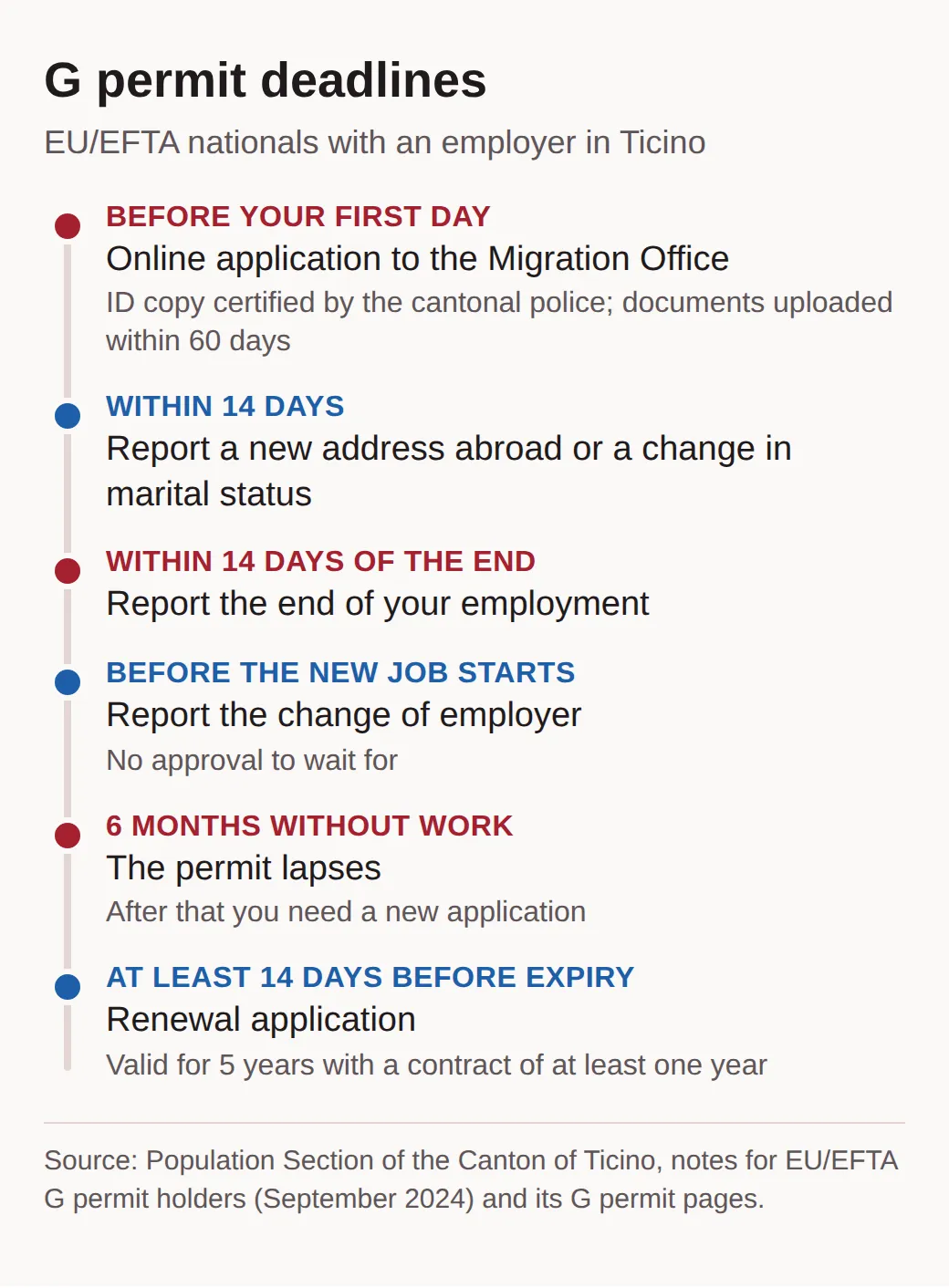
If you have just received an offer in Ticino, here is what to do. Check that your ID is valid for travel abroad. Ask your future employer for a signed contract with the start date, duration, workload and salary. Stop at one of the police stations for the certified copy, then open the online application and upload everything straight away, so you don't pay for reminders. On the day your card arrives, put the expiry date minus two weeks in your diary.
If you have questions about your own case, the Migration Office answers on +41 91 814 55 00, Monday to Friday, from 8 am to noon and from 1.30 pm to 5 pm. A phone call before you sign costs less than a procedure you have to redo afterwards.
Common questions
- Can I work in another canton with a G permit?
- If you are an EU/EFTA national, yes. The EU/EFTA G permit is valid throughout Switzerland, and the Agreement on the Free Movement of Persons guarantees occupational and geographical mobility across the whole country. For third-country nationals, a permit issued by Ticino is valid only in the canton of Ticino.
- Can self-employed people get a G permit?
- Yes, if they are EU/EFTA nationals. The Agreement on the Free Movement of Persons provides self-employed cross-border commuters with a special permit valid for at least five years, as long as they show that they work, or intend to work, on a self-employed basis. Ticino publishes separate notes for this case, apart from those for employees.
- What should I do if I lose my G permit card?
- Apply for a duplicate from the Ticino Migration Office through the online procedure. For an adult EU/EFTA national it costs CHF 60, plus CHF 15 if a new photo and signature are needed. For third-country nationals a duplicate costs CHF 55.
- Can I move to Ticino with a G permit?
- No. The G permit is for people who work in Switzerland without moving their residence there. You may sleep in a Swiss municipality during the week if you register there, but your main home stays abroad. To live in Ticino you need to apply to the Migration Office for a different type of permit.
More posts
All posts
Cross-border family allowances: who pays what in 2026
Family allowances for cross-border workers in Ticino: when INPS pays first, what Switzerland adds, how to apply and how many years of arrears you can claim.

Ticino minimum wage 2026 and 2027: rates by sector
Ticino minimum wage: CHF 20.00 to 20.50 an hour in 2026, 20.50 to 21.00 from 2027. Rates by sector, collective agreements, what counts and how to claim.

Ticino cross-border workers: 2026 tax under new agreement
Old and new cross-border workers in Ticino: 2026 tax at source, Irpef above the €10,000 allowance, 25% home working and the 25% option, with worked figures.