Cross-border family allowances: who pays what in 2026

The short answer
It depends on the other parent. If they work in Italy, or receive NASpI, Italy's unemployment benefit, INPS pays first with the Assegno unico, and Ticino only adds the difference up to CHF 215 a month per child, or CHF 268 for a child in education. If the other parent doesn't work, Ticino pays the full allowance. You apply through your employer, and the claim goes to its family allowance fund.
In practice, the difference can be large or close to nothing. For a nine-year-old, Ticino adds about CHF 26 a month on top of the full Assegno unico, and CHF 161 on top of the minimum amount. Below we explain where these figures come from, which documents the fund asks for, how many years of arrears you can recover and why, since 2022, data between INPS and the Swiss funds hasn't flowed the way it should.
How much Ticino pays in 2026
Ticino pays the minimums set by the federal Family Allowances Act (FamZG): CHF 215 a month for each child up to age 16 and CHF 268 for each child in education or training, up to age 25. The Federal Social Insurance Office (FSIO) lists them as the national minimum child allowance and education allowance. These amounts have applied since 1 January 2025, when the Confederation raised them for the first time since 2009, and Ticino adds nothing of its own. The canton's social insurance institute, the IAS (Istituto delle assicurazioni sociali), gives the same figures on its page on child and education allowances, which exists only in Italian.
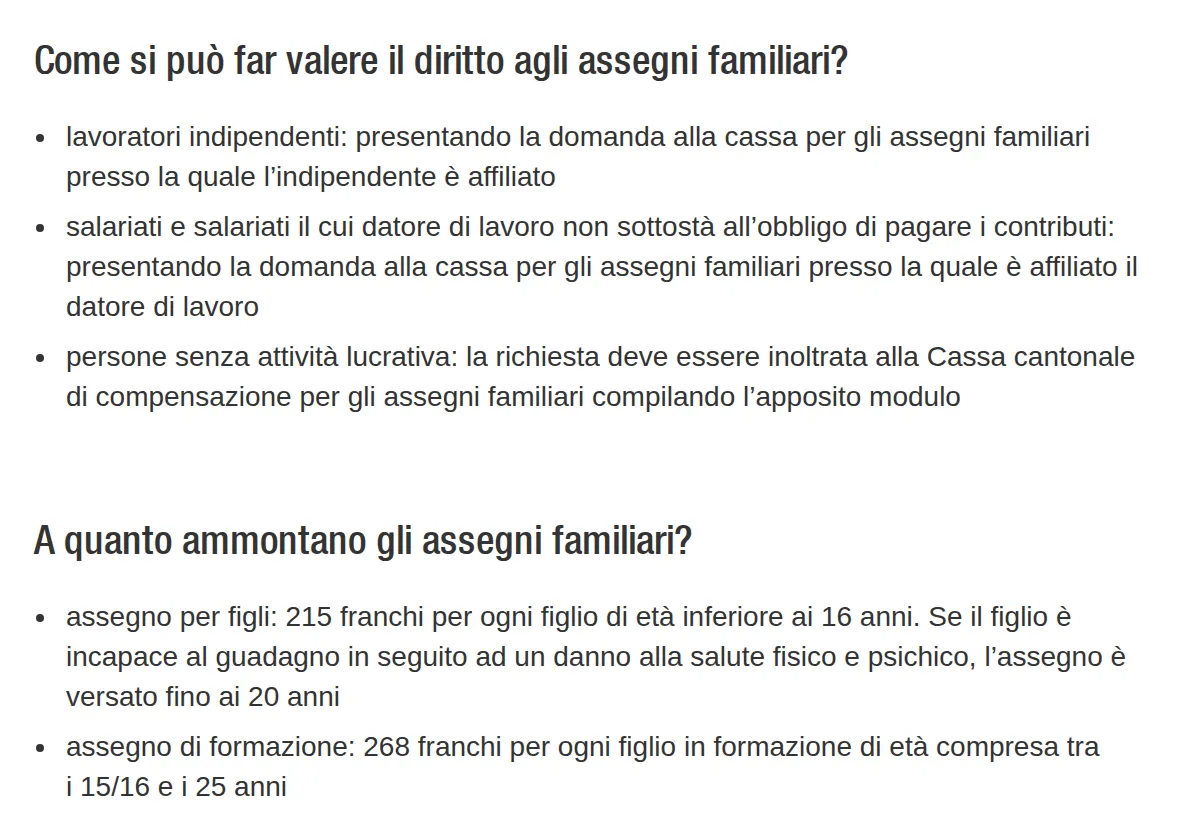
The IAS's 2026 information sheet (in Italian) adds the rules that matter if you commute. You're entitled to allowances if you earn at least CHF 630 a month. Above that threshold the allowance is always paid in full, even if you work 40%. Only one allowance is paid per child, even if you have two employers. The education allowance starts at age 15 if your child has already begun post-compulsory education, and it's lost if your child earns more than CHF 2,520 a month.
For a child living in Italy, the allowance crosses the border if you're a Swiss citizen or a citizen of an EU or EFTA state: that's what the IAS export table says, and the FSIO page on children living abroad confirms it. For citizens of other countries the allowance isn't exported. EU Regulation 883/2004, which Switzerland applies under the Agreement on the Free Movement of Persons, adds one more point: for family members living in another state, the amount can't be cut to match local purchasing power. A child in Varese is worth as much as a child in Lugano.
Not everything crosses the border, though. Ticino's extra cantonal benefits, meaning the supplementary and early childhood allowances and the CHF 3,000 parental allowance paid at birth, are reserved for people who have lived in Ticino for years. For a cross-border worker, that leaves the CHF 215 and 268. The question is who pays them first.
Assegno unico or Swiss allowances: who pays first?
Article 68 of Regulation 883/2004 decides who pays first, and what counts is the basis of the entitlement, not who pays more. An entitlement that comes from work ranks before one that comes from a pension, which in turn ranks before one based on residence alone. If the entitlement comes from work in both countries, the country where the children live takes priority.
For a cross-border family, that means: if the other parent also works in Italy, both entitlements come from work and the children live in Italy, so Italy pays first. The IAS spells this out in its June 2026 paper on cross-border workers and EU law: the Swiss allowance is suspended up to the Italian amount and paid only for the part above it, the so-called differential supplement.
If the other parent doesn't work, on the other hand, the Italian entitlement comes from residence alone and drops to second place. Ticino then pays the whole amount, and Italy, in theory, only has to add whatever exceeds the Swiss allowance. An unemployed person receiving NASpI counts as if they were working: the EU's Administrative Commission treats periods of unemployment on benefit as work, which is why the IAS form puts them in the same box: salariato, disoccupato o lavoratore autonomo in Italia (employee, unemployed or self-employed in Italy).
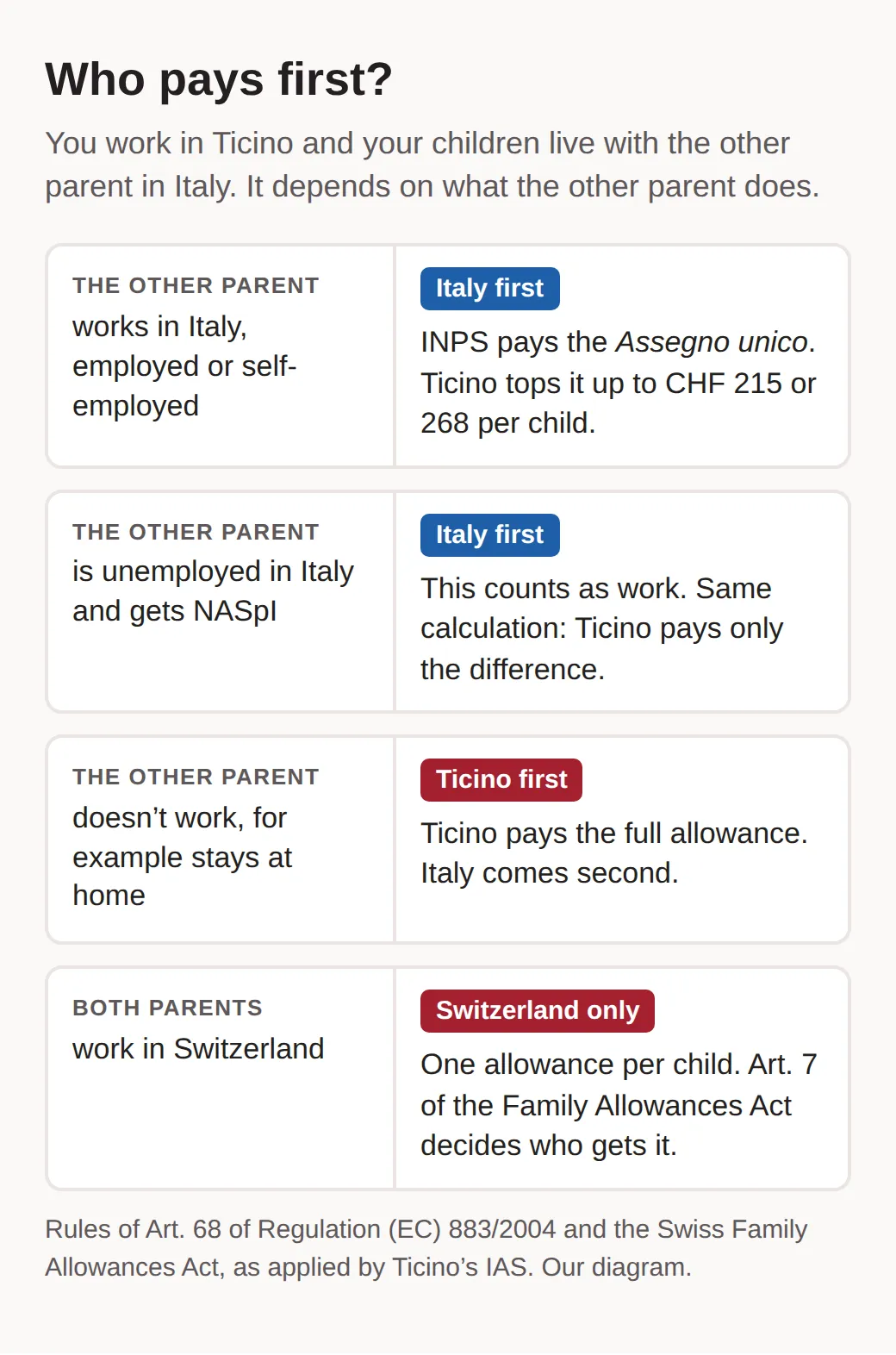
When both parents work in Switzerland, only Swiss law applies: one allowance per child, and who receives it follows the order in Article 7 of the FamZG. That order looks first at who is in paid work, then at parental authority, at who the child lives with and, among the last criteria, at the higher income. The most common case, though, is still the first one, with one parent on each side of the border. That's where you need to do the maths.
Working out the difference, child by child
The Swiss fund compares the amounts one child at a time, not for the whole family. That's set by Decision No. 147 of the EU Administrative Commission, as explained in the FSIO guide on family benefits between Switzerland and the EU (in Italian). The same guide says the euro amount is converted at the European Central Bank's daily rate on the day the fund does the calculation.
Take a family from Como, made up but typical: one parent works in Mendrisio, the other is employed in Italy, the children are 9 and 17, and the older one is at upper secondary school. For 2026, the INPS page on the Assegno unico (in Italian) gives €203.80 per minor child with an ISEE (Italy's household means test) of up to €17,468.51, and €58.30 with no ISEE or an ISEE of €46,582.71 or more. At the ECB reference rate of 19 October 2026, CHF 0.9261 to the euro, the figures look like this:
| Child | Swiss amount | Full Assegno unico | Difference paid by Ticino |
|---|---|---|---|
| Aged 9 | CHF 215.00 | CHF 188.74 | CHF 26.26 |
| Aged 17, at school | CHF 268.00 | CHF 188.74 | CHF 79.26 |
| Total per month | CHF 483.00 | CHF 377.48 | CHF 105.52 |
With the minimum Assegno unico, CHF 53.99 per child, the difference rises to CHF 161.01 for the younger child and CHF 214.01 for the older one: CHF 375.02 a month, about CHF 4,500 a year. Either way, the family receives CHF 483 a month in total, no more and no less. All that changes is how much comes from INPS and how much from the Swiss fund.
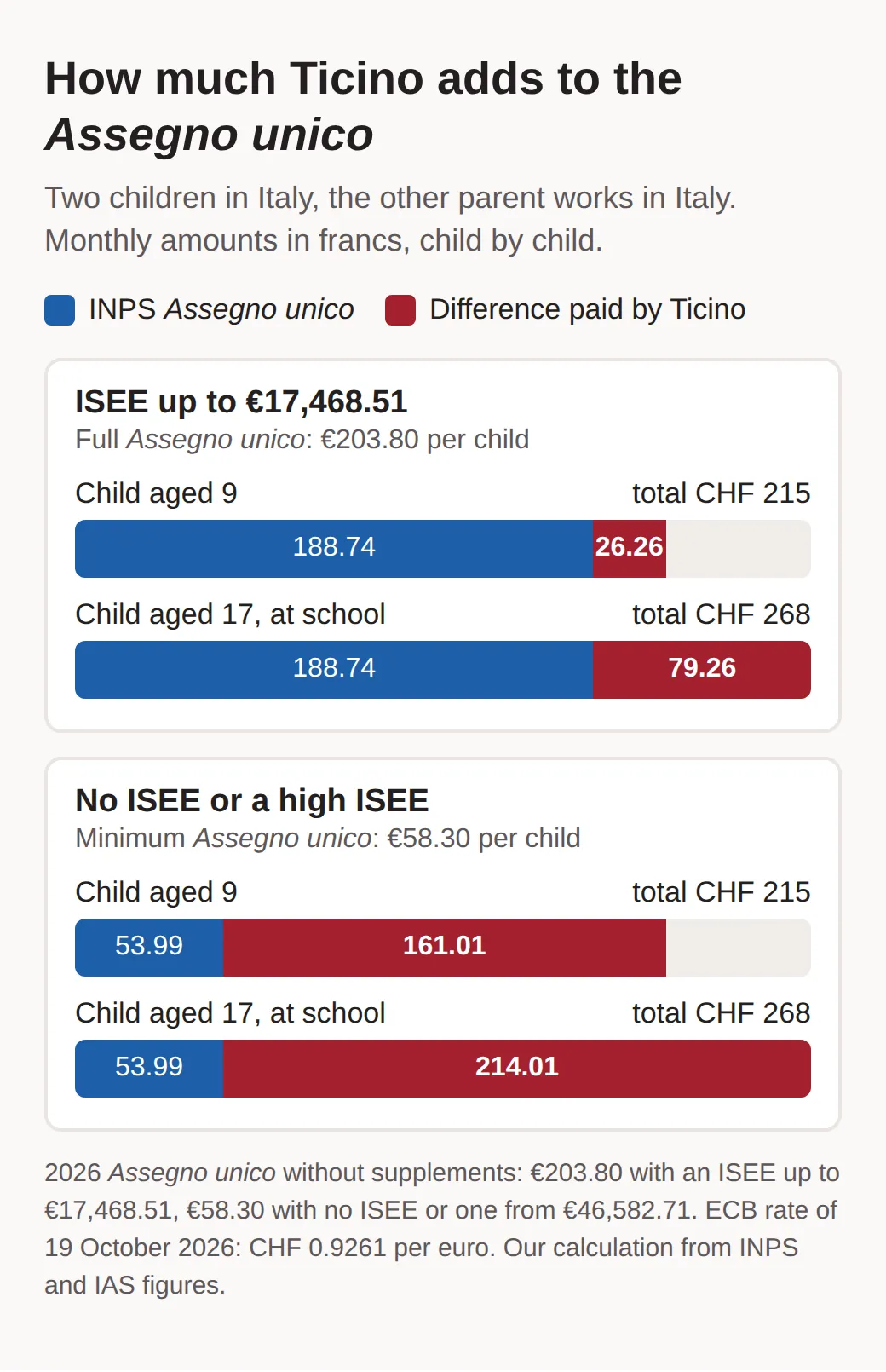
Three caveats on the calculation. We used the basic Assegno unico: INPS adds supplements, for example for children under one or when both parents earn an income from work, and the Swiss fund counts everything the individual child actually receives, supplements included. The exchange rate moves, so the difference shifts by a few centimes from one calculation to the next. And the ISEE is renewed every year: from March the INPS amount can change, and the Swiss share with it.
Skipping the Assegno unico doesn't pay
Some people think that if nobody applies to INPS, Ticino will pay the full allowance. It won't. The federal guide is clear: what counts for the difference is that an entitlement exists in Italy, not whether the benefit is actually paid. If the other parent works in Italy and doesn't apply, the Swiss fund can act as if the Assegno unico were being paid anyway. The family loses the Italian share and doesn't get it back from Switzerland. That's why the first step, even before the Swiss form, is the application to INPS.
How to apply: form, documents, fund
Your application doesn't necessarily go to the IAS: it goes to the family allowance fund your employer belongs to. Ticino doesn't have just one. The IAS list for 2026 counts 41 authorised funds, from the cantonal fund run by the IAS in Bellinzona to sector funds such as those of GastroTicino, the Ticino banks, Migros or Coop. If you work for a company with its head office or a branch in Ticino, you get the Ticino amounts, as Article 12 of the Family Allowances Act provides. The first step is to ask HR which fund the company uses.
The procedure at the IAS cantonal fund shows what you'll need. The application form for employees is six pages long. You fill in the first part, your employer fills in and signs the second, then you complete the rest, sign it and send the whole thing to the fund. There's a separate section for children living in Italy, section 5, and the IAS only processes complete forms with every attachment:
- if the other parent is employed, unemployed or self-employed in Italy: the receipt for the Assegno unico application submitted to INPS, an INPS payment statement showing the monthly amount (for example from the cassetto previdenziale on MyINPS) and the address of the responsible regional INPS office;
- if the other parent stays at home: a declaration signed by them, with a copy of an identity document;
- if you aren't a Swiss citizen: a copy of your Swiss permit, which for a cross-border worker is the G permit;
- if you live abroad: your marriage certificate, where applicable, and the EU form E401 on family composition;
- for a child over 16 studying in Italy: form E402 for school or E403 for an apprenticeship.
Documents in Italian are perfectly fine, since Italian is a Swiss national language. If your documents are in another language, you have to attach an Italian translation made by an official body, such as a trade union or an embassy; the European E-series forms don't need one. Other funds use their own forms, but the European rule is the same and they'll ask for similar documents.
Once approved, the allowance comes with your salary: as the IAS page on allowances and the employer explains, your employer advances it and the fund then reimburses the employer. From then on, any change has to be reported within 10 days, to both the employer and the fund: a new job for the other parent, a child finishing school, a new INPS amount after the ISEE is renewed. That's what makes the difference between back pay to collect and money to repay.
Arrears: up to five years, and the risk of paying back
If you've never claimed Swiss allowances, you can recover them for up to five years back. Article 24 of the Federal Act on the General Part of Social Insurance Law (ATSG, in Italian), which also covers family allowances, says the right to outstanding benefits expires five years after the end of the month for which they were due. That's why the IAS form asks from what date you're claiming the allowances. For our family with the high ISEE, that's about CHF 4,500 for every year left unclaimed.
On the Italian side the deadlines are tighter. According to INPS, an Assegno unico application made between 1 March and 30 June is paid retroactively from March; after 30 June the benefit only starts from the month after the application. Since Ticino can work out the difference as if the Assegno unico were being paid anyway, a delay in Italy means months lost for good.
The opposite risk is being paid too much. If the Italian amount isn't known, the Swiss fund can pay the difference in advance and correct the calculation later. According to the federal guide, overpayments can be deducted from the following months' allowances. Otherwise the fund asks for the money back, which under Article 25 of the ATSG it can claim up to three years after learning of the overpayment, and at most five years after it was paid. You only escape repayment if you acted in good faith and repaying would cause you serious hardship. One example: the ISEE changes in March, the Assegno unico goes up, nobody tells the fund, and the Swiss difference stays at the old amount for months.
The INPS data problem and the EU court case
The system's weak spot is data exchange. To work out the difference, the Swiss fund needs to know the Italian amount, and since 2022 the exchange with INPS hasn't worked as it should. The problem reached the federal parliament through a motion by National Councillor Lorenzo Quadri, number 26.3206, submitted on 18 March 2026. It asked the Federal Council to put pressure on INPS in Lombardy and, if nothing changed, to consider stopping allowances for Italian cross-border workers.
The Federal Council's reply of 6 May 2026 explains where the clash comes from. Italy doesn't regard the Assegno unico, in force since 1 March 2022, as a family benefit to be coordinated under EU law, and so it doesn't exchange data the way it would for a traditional family allowance. The European Commission opened infringement proceedings against Italy, and the Court of Justice of the European Union has to rule. The Federal Council expects the Court to recognise the Assegno unico as a benefit to be coordinated; INPS would then be obliged to transmit the data electronically.
In the meantime, the Federal Social Insurance Office has advised the funds to ask families for the data directly, which is why the IAS wants the INPS payment statement. Suspending the allowances, on the other hand, is ruled out: according to the Federal Council it would breach the Agreement on the Free Movement of Persons, which is why it proposed rejecting the motion. At the time of the May reply, a ruling was expected shortly. Until the data flows electronically, it's the INPS documents you hand in to the fund that decide the figure: if they're out of date or incomplete, a wrong difference can surface later, in the form of a demand for repayment.
In the background there's also a proposal to raise the Swiss minimums to CHF 250 and 300, the Jost parliamentary initiative. In April 2026, after the consultation, the National Council's Social Security and Health Committee proposed writing it off, on its chair's casting vote. On 19 June 2026, however, the National Council voted 109 to 88 to keep it alive and extend the deadline to 2028. An increase would still need a change in the law passed by both chambers: for now, the amounts stay at CHF 215 and 268.
What to do if you're starting work in Ticino
If you've just signed a contract in Lugano or Chiasso, the order is simple. The other parent applies for the Assegno unico or updates the application, ideally by 30 June so as not to lose months. You ask your employer which fund it uses, get the right form, have the employer sign their part and attach the INPS receipt, the statement with the amount and the EU forms. Then, once the fund has decided, check your payslip: the Swiss allowance should appear as a separate line.
Allowances aren't the only thing that changes when you cross the border. The tax rules under the new agreement are in our guide to cross-border workers' taxes, and what happens if your job ends is covered in our article on unemployment for cross-border workers. For the allowances, there's only one rule to remember: whenever something changes in Italy, the Swiss fund has to know within ten days.
Common questions
- Do part-time workers get the full child allowance in Switzerland?
- Yes, as long as you earn at least CHF 630 a month, or CHF 7,560 a year. The IAS only pays full allowances, whatever your percentage of employment. If you have two employers, you still get only one allowance per child, and you have to declare the other job on the form too.
- Can I still get the allowance for an adult child studying in Italy?
- Yes, up to age 25, as long as your child is still in education or training: that's the education allowance of CHF 268 a month. For a school or university in Italy you need form E402, for an apprenticeship form E403. The entitlement ends if your child earns more than CHF 2,520 a month.
- Is there a Ticino birth allowance for cross-border workers?
- No. Ticino's parental allowance of CHF 3,000 requires the parent to have lived in Ticino for at least three years if Swiss, or five years if foreign, and the child to live in Ticino. The same applies to the canton's supplementary allowance and its early childhood allowance. The Swiss child allowance, on the other hand, starts from the month of birth.
- Who gets the child allowance if the parents are separated?
- It goes to the person entitled to it under the priority rules. But if the money doesn't reach the child, the person caring for the child can ask the Swiss fund to pay it to them directly, even into an account in Italy. The fund covers the cost of the transfer abroad, but not the receiving bank's charges.
- What happens to my family allowances if I'm off sick or on maternity leave?
- If you're ill or have an accident, the allowance continues for the month your absence starts and the three months after. During maternity leave it continues for up to 16 weeks, even without a salary. If you lose your job, though, you lose the Swiss allowance as well: an unemployed cross-border worker gets unemployment benefit from Italy, and from then on family benefits follow the Italian rules too.
More posts
All posts
G permit in Ticino: requirements, renewal and changing jobs
Ticino G permit in 2026: who qualifies, where you can live, the weekly return rule, applying online, fees, five-year renewal and changing employer.

Ticino cross-border workers: 2026 tax under new agreement
Old and new cross-border workers in Ticino: 2026 tax at source, Irpef above the €10,000 allowance, 25% home working and the 25% option, with worked figures.

Ticino B permit: requirements, fees and G permit compared
B permit in Ticino for EU citizens: who qualifies, applying and fees at the Migration Office, tax and health insurance as a resident, the C after 5 years.