Cross-border worker unemployment 2026: NASpI, U1, who pays

The short answer
If you live in Italy and lose your job in Ticino, Italy pays your unemployment benefit: it's NASpI, paid by INPS, worked out on your Swiss salary but capped at €1,584.70 gross a month in 2026. Switzerland only pays while your contract is still running, for example during short-time work. Your Swiss years count thanks to the U1 form.
For many people it comes as a nasty surprise. For years they've watched 1.1% of their salary go to Swiss unemployment insurance, and on the day they need it they find out the money comes from INPS, Italy's national social security institute, under Italian rules and at Italian rates. Below we explain who pays in which case, what NASpI is really worth if you earned in francs, how to get the U1 form, what happens if you lose only part of your work, and what changes with the EU reform adopted in September 2026.
Who pays: first the contract, then where you live
If you've lost your job completely, the country where you live pays. That's the rule in Article 65 of EU Regulation 883/2004, which Switzerland applies through the Agreement on the Free Movement of Persons. The INPS page for cross-border workers (in Italian) says so plainly: if you live in Italy and were insured in another country, you receive NASpI, even if you were never insured in Italy. On the Swiss side, SECO's page on Regulation 883/2004 confirms that under the current rules the country of residence pays the benefit and checks your job search.
One distinction confuses a lot of people. For tax purposes you're a cross-border worker if you live within 20 km of the border and go home every day, as our article on cross-border workers' taxes explains. For unemployment the definition is wider: the regulation treats anyone who goes home, as a rule, every day or at least once a week as a cross-border worker, with no distance limit. SECO's directive on Regulation 883 (in Italian), the text Swiss unemployment funds work from, calls both daily and weekly commuters "genuine" cross-border workers (veri frontalieri). If you sleep in Lugano from Monday to Thursday and go back to Bergamo on Friday, as the G permit allows, you're still a cross-border worker for unemployment purposes and you get NASpI. The same directive warns, though, that the funds ask weekly commuters for strong proof, because the starting assumption is that people live where they work. It pays to be able to show that your home, your family and your life stayed in Italy.
If you went home less than once a week, SECO calls you a "false" cross-border worker (falso frontaliere). You have a choice: you can claim NASpI in Italy, or the Swiss benefit by making yourself available to the employment services in Switzerland. If you choose Italy, it's up to you to show convincingly that you hadn't settled in Switzerland. If you choose Switzerland, the Swiss conditions apply, starting with 12 months of contributions in the last two years.
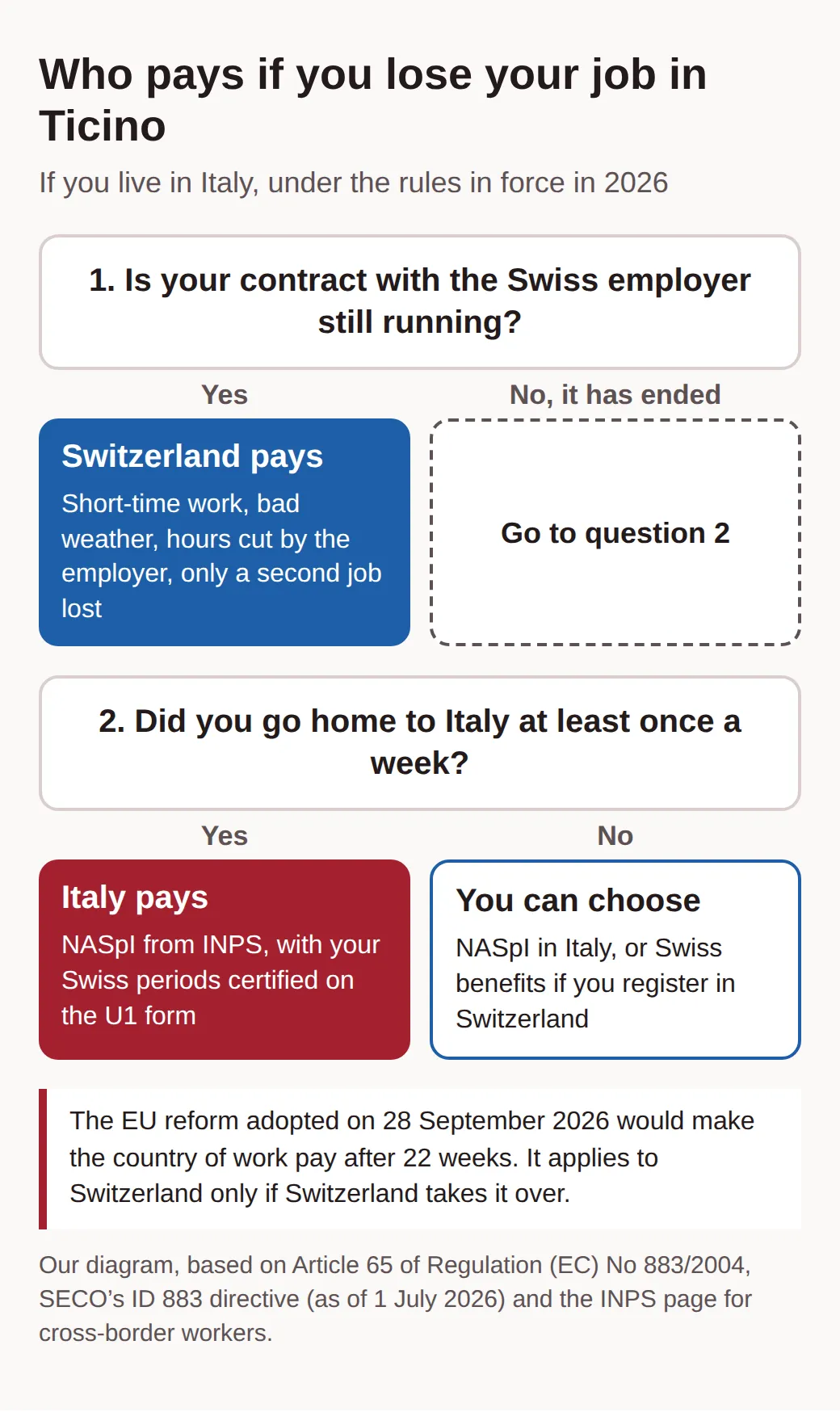
The first fork in the diagram, however, comes before where you live: what matters is whether your contract with the Swiss employer is still running. That's the situation for partially unemployed cross-border workers, covered further down. For the vast majority, people who've been dismissed and are looking for work from home, INPS foots the bill.
How much NASpI do you get if you were paid in francs?
Almost every full-time cross-border worker gets the maximum: €1,584.70 gross a month in 2026. The calculation follows the INPS page on NASpI (in Italian). INPS takes your pay over the last four years, divides it by your weeks of contributions and multiplies it by 4.33: the result is an average monthly wage. NASpI is 75% of that wage up to a threshold, plus 25% of the part above it. INPS circular no. 4 of 2026 (in Italian) sets the threshold at €1,456.72 and the cap at €1,584.70.
For a cross-border worker the base is the Swiss salary. The INPS page for cross-border workers says the amount is calculated on the pay received in the country of last employment, always within the cap. We did the maths: the cap kicks in once the average monthly wage goes above €3,425.36. At the ECB reference rate of 16 October 2026, CHF 0.9272 to the euro, that's about CHF 38,100 gross a year. That's less than a full-time job paid at the Ticino minimum wage: the lowest rate in 2026 is CHF 20 an hour, which at 42 hours a week comes to CHF 3,637.20 a month, or CHF 43,646 over a year of 12 monthly payments.
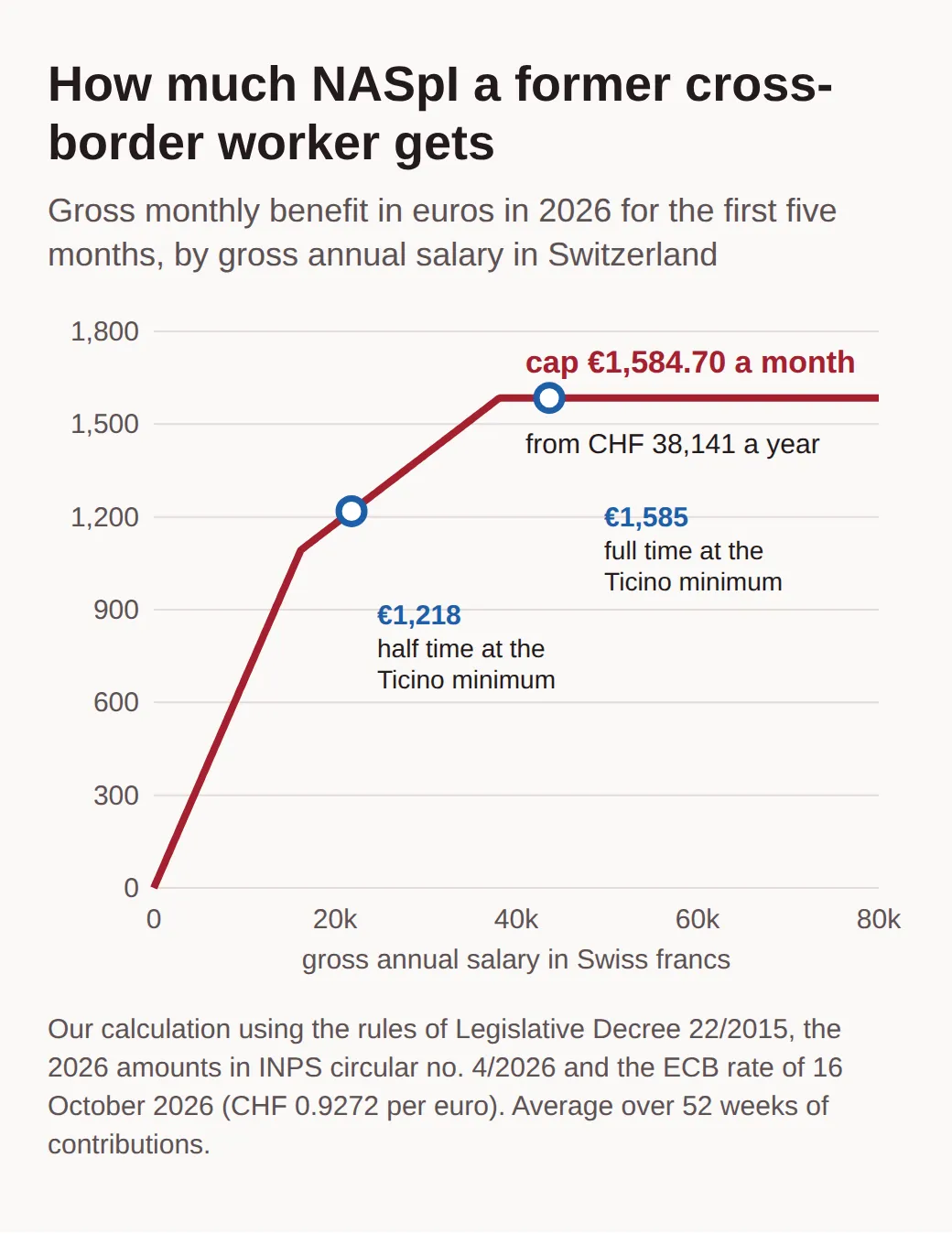
The chart shows what follows. Below about CHF 38,100 a year, NASpI rises with your salary; above it, the line stays flat. If you worked half time on the minimum wage, you get about €1,218 a month; if you worked full time, even on the minimum, you get the cap. INPS may use a different exchange rate from ours, but for a full-time job the result doesn't change. If you earned CHF 6,000 a month over 13 payments, the drop is steep: NASpI is worth just over a fifth of your average gross pay.
Then the amount goes down. NASpI shrinks by 3% a month from the first day of the sixth month, or of the eighth month if you were 55 or older when you applied. It lasts for half the weeks of contributions in the last four years. Four full years in Ticino give you NASpI for 104 weeks, about two years; one year gives you 26 weeks. Weeks that already counted towards an earlier unemployment benefit don't count a second time. For any of this to work, though, INPS needs to know how long you worked in Switzerland.
The U1 form: what it is and where to ask for it
The PD U1 form is the document that proves your Swiss work periods to INPS. Without them, someone who has only worked in Ticino wouldn't even have the 13 weeks of contributions NASpI requires. The INPS page explains that the country of residence counts the periods built up in the country of last employment as if they were Italian, and lists what to attach to your application.
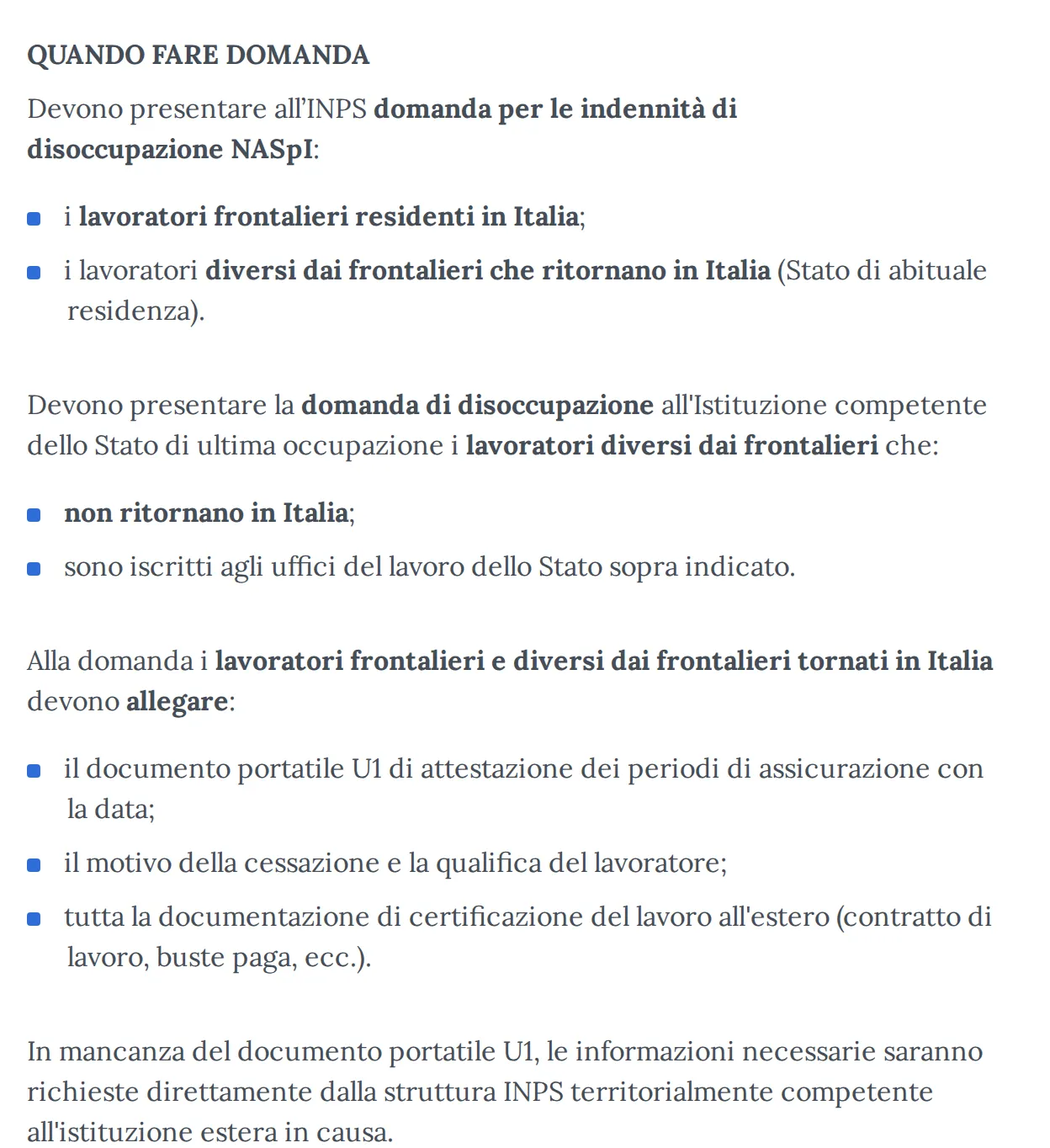
You ask for the form at a Swiss unemployment insurance fund, not at the AVS compensation office or your employer. SECO's directive sets out which fund is responsible. If you've received Swiss unemployment benefit before, you go back to the fund that paid it. Otherwise you choose among the funds covering the area where your last employer is based, or the area where you slept, if you stayed in Switzerland during the week. The request has to be in writing, on the form Richiesta di rilascio del modulo PD U1 (application for a PD U1), which you'll find on SECO's page of eServices and forms for unemployment benefit (forms in German; the Italian version of the page has them in Italian), together with a copy of your ID. Each Swiss employer you've had in recent years fills in an international employer's certificate (Attestato del datore di lavoro internazionale), which the fund uses to work out your periods and gross salary.
One detail is worth knowing. The request form dates from 2012 and its back page says Italy needs two years of periods. NASpI, however, looks at the last four years, both for whether you qualify and for how long it's paid. Our advice: list every Swiss period from the last four years, and attach a certificate from each employer in that time.
If the form doesn't arrive in time, apply anyway. The INPS page says that, without the PD U1, the local INPS office asks the Swiss institution for the data itself. That delays the payments, not the deadline for applying. This is why Unia's unemployment insurance fund, in its leaflet on the PD U1, advises ordering it during your notice period and says it's sent within a week once the file is complete.
Applying to INPS: 68 days and a service agreement
You must apply for NASpI within 68 days of the end of your contract: online, through the INPS contact centre or through a patronato, one of Italy's free welfare advice offices. If you apply by the eighth day, NASpI starts on the eighth day after your job ended; if you apply later, it starts the day after your application. So every week you wait is a week you don't get paid.
The application also counts as a declaration that you're immediately available for work. Within the next 15 days you have to go to the job centre (centro per l'impiego) to sign a personalised service agreement (patto di servizio personalizzato); otherwise the centre will call you in. From then on, Italian rules apply: interviews, courses, job offers to consider. Ignore them without a valid reason and your benefit can be cut, or stopped altogether.
As a cross-border worker you can also register in Switzerland, to look for work where you looked before. Both the INPS page and the SECO directive allow it: the regional employment centre (URC in Ticino, RAV in German-speaking Switzerland) registers you as a jobseeker with no entitlement to benefit, and if you had no accommodation in Switzerland, the URC for the area of your last employer is responsible. You must tell the job centre and INPS that you've registered in Switzerland, and your obligations to Italy come first. If you're looking in Ticino again, keep an eye on your G permit too: according to the Migration Office's notes (Ufficio della migrazione, in Italian), it stops being valid six months after your work ends, and within that time you can change jobs without waiting for a new authorisation, as long as you report the change before you start.
Dismissal or resignation: what INPS looks at
NASpI only covers losing your job involuntarily. If you were dismissed in Ticino you qualify; if you resigned, as a rule you don't. The exceptions are those in Italian law, listed on the NASpI page: resigning for just cause, such as unpaid wages or workplace bullying, resigning during the protected period of maternity or paternity leave, and some mutual terminations provided for by law. That's why INPS asks, besides the U1 form, for the reason your job ended and the papers from your Swiss job, from the contract to the payslips. Keep your employer's notice letter.
Since 2025 there's also a rule for people who change jobs. Italy's 2025 budget law added a requirement to Article 3 of Legislative Decree 22/2015: if you resigned from a permanent job in the twelve months before your dismissal, you need at least 13 weeks of contributions built up after that resignation. So if you leave a permanent job for an offer in Ticino and lose the new one after a few weeks, during your probation period for instance, you risk getting no NASpI at all. Before you resign, it's worth knowing the safety net has this hole.
Partially unemployed cross-border workers: when Switzerland pays
If your contract with the Swiss employer continues, Switzerland pays, even though you live in Italy. That's the Article 65 rule for "partial or intermittent" unemployment. SECO's directive defines it with a simple test: what counts is whether the employment relationship exists, not how long the work is suspended. If you still have a contract with the same company and can go back to your job, you're partially unemployed and Switzerland stays responsible. If you have no contract at all, you're fully unemployed and INPS takes over.
In practice there are four cases. The first is short-time work, when the company cuts hours because orders drop for a while. Short-time working compensation covers 80% of the lost earnings: your employer pays it on payday and the fund reimburses the employer. SECO's brochure (in Italian) states that cross-border workers are entitled to it from their first day in the job, as long as the contract isn't fixed-term. The second is bad weather: in construction, landscape gardening, quarries and a few other sectors, bad weather compensation likewise covers 80% of the hours lost to the weather.
The other two cases concern people left with less work. If your Swiss employer lowers the percentage written in your contract, say from 100% to 60%, and keeps you on, SECO's directive says Switzerland remains responsible: Italy only takes over when you're fully unemployed. The same goes if you lose a second, part-time job in Switzerland and keep your main one. In these two cases Switzerland applies the Unemployment Insurance Act, which treats as partially unemployed anyone who has a part-time job and is looking for a full-time one or another part-time one. So you need to register with the URC and meet the Swiss requirements. SECO tells the funds to check that the contracts aren't fictitious, and the rule doesn't apply to a string of fixed-term contracts.
Your employer going bankrupt is a separate case. Insolvency compensation, the SECO directive points out, isn't an unemployment benefit under the EU regulation. Swiss law grants it to employees who pay contributions and whose employer has staff in Switzerland, and it covers unpaid wages for at most the last four months of the same employment. It's about work you've already done, so it's a different thing from NASpI, which covers the time after your contract ends.
Contributions in Switzerland, reimbursements to Italy
Cross-border workers fund Swiss unemployment insurance, but Italy pays their benefit. The contribution is 2.2% of salary up to CHF 148,200 a year, half paid by the employee and half by the employer, according to AVS leaflet 2.08 (in Italian). In return, Switzerland reimburses part of the benefits to the country of residence: usually three months of benefits, or five if the cross-border worker worked in Switzerland for more than 12 of the last 24 months. The reimbursed months are calculated under the rules of the country of residence, so with NASpI and its cap. The figures SECO publishes for Italy, in millions of francs, show the imbalance.
| Year | UI contributions of cross-border workers living in Italy | Swiss reimbursements to Italy |
|---|---|---|
| 2018 | 83.3 | 9.7 |
| 2019 | 86.2 | 9.8 |
| 2020 | 88.0 | 8.9 |
| 2021 | 92.4 | 27.3 |
| 2022 | 98.4 | 17.3 |
| 2023 | 102.5 | 14.1 |
| 2024 | 103.5 | 17.4 |
| 2025 | 103.5 | 21.1 |
In 2025, reimbursements to Italy came to about a fifth of the estimated contributions. From 2018 to 2025 they add up to CHF 125.6 million against CHF 757.8 million in contributions, about 17%. SECO warns that the contributions are an estimate, and the sum doesn't tell the whole story: out of the same contributions Switzerland also pays short-time working and bad weather compensation for cross-border workers still in their jobs. But it explains why Brussels spent years debating a change to who pays.
The 2026 EU reform and what it means for Switzerland
The European Union has changed the rule, but for cross-border workers in Switzerland nothing changes for now. The European Parliament approved the revised regulation on 7 July 2026, with a text that rewrites Article 65. The Council adopted it on 28 September 2026, as its voting result records. Under the new rules, an unemployed cross-border worker gets benefits from the country where they worked. Only those who haven't completed 22 weeks of uninterrupted work in the country of work stay with their country of residence. Reimbursements between countries disappear.
Even inside the EU it will take a while. The regulation enters into force on the first day of the month after its publication in the Official Journal of the EU, and the new unemployment rules apply 24 months later. In its update of 1 October 2026, SECO said publication hadn't happened yet. Luxembourg, where cross-border workers make up a huge share of the workforce, secured five years from entry into force, which can be extended to seven.
For Switzerland the switch isn't automatic. SECO explains that the revision isn't part of the package of agreements between Switzerland and the EU, because it hadn't been adopted yet when they were negotiated. It will have to be discussed in the Joint Committee of the Agreement on the Free Movement of Persons, where Switzerland could ask for longer transition periods. There's no legal obligation to adopt it, and any adoption would go through Switzerland's domestic procedures, including a possible referendum. SECO puts the extra cost for Swiss unemployment insurance at between CHF 500 million and CHF 800 million, figures it describes itself as very rough. If the rule ever reached Switzerland, a cross-border worker dismissed after at least 22 weeks would register with the URC and, if they met the Swiss requirements, receive Swiss unemployment benefit, which is 70% or 80% of insured earnings. Until then, if you lose your job in Ticino, NASpI is what you get.
What to do before your last day
Your notice period is the time to get everything ready, not the day your contract ends. Ask your employer straight away for the international employer's certificate, and send the PD U1 request to the unemployment insurance fund with every Swiss period from the last four years. Keep your notice letter, your contract and your last payslips: INPS asks for them together with the reason your job ended.
The day after your job ends, apply for NASpI, even without the U1: by the eighth day you lose nothing, and up to the 68th day you lose only the days you waited. Then book your appointment at the job centre and, if you want to work in Ticino again, register with the URC as well and tell INPS. If your employer offers you short-time work or a lower percentage instead, that isn't a dismissal: in that case, the door to knock on is Swiss.
Common questions
- Can I get NASpI if I lived in Ticino on a B permit and move back to Italy?
- Usually not. INPS states that NASpI isn't paid to people whose last job was abroad, except cross-border workers and a few other groups. If you really lived in Switzerland, you claim Swiss unemployment benefit and can take it to an EU country for up to three months, once you have been registered with the regional employment centre for at least four weeks. The old Italian benefit for returning workers only covers jobs that ended by 31 December 2024.
- Can self-employed cross-border workers claim unemployment benefits?
- Not in Switzerland: SECO points out that Swiss unemployment insurance doesn't cover the self-employed, so if you close down your own business in Ticino you get nothing from Switzerland. In Italy, NASpI is only paid to people who were employees. So only your periods as an employee are covered.
- Is NASpI taxable for former cross-border workers?
- Yes. INPS notes that NASpI is taxable income and also counts towards the ISEE, Italy's indicator of a household's financial situation. That's why the amounts in this article are gross. How much you keep depends on your other income that year and the deductions you're entitled to.
- What happens to my NASpI if I take a short job in Ticino?
- The INPS page on NASpI says that a new job in an EU country also suspends NASpI. For an employment contract the dividing line is six months: up to six months, NASpI is suspended for as long as the job lasts; beyond six months it lapses, and when the contract ends you have to apply again. You report the new job to INPS through its NASpI-Com service.
More posts
All posts
Ticino B permit: requirements, fees and G permit compared
B permit in Ticino for EU citizens: who qualifies, applying and fees at the Migration Office, tax and health insurance as a resident, the C after 5 years.

Cross-border family allowances: who pays what in 2026
Family allowances for cross-border workers in Ticino: when INPS pays first, what Switzerland adds, how to apply and how many years of arrears you can claim.

Swiss pension for cross-border workers: AVS, LPP, Italy's 5%
Cross-border workers living in Italy: what your AVS pension is worth, where to claim it, LPP annuity or lump sum, Italy's 5% tax and the Swiss tax refund.