Ticino minimum wage 2026 and 2027: rates by sector

The figures at a glance
In 2026 the minimum wage in Ticino is CHF 20.00 to 20.50 gross an hour, depending on your employer's sector. From 1 January 2027 it rises to a range of 20.50 to 21.00, then 21.00 to 21.50 in 2028 and 21.75 to 22.25 in 2029. In 2026 it doesn't apply if you're covered by a collective agreement with its own minimum; from 2027 it does, after a transition period.
The number alone tells you little, because the law only sets an hourly rate. On a contract of 42 hours a week with 12 monthly salaries, you must be paid at least CHF 3,637.20 a month at the lowest 2026 rate, and 3,728.13 at the lowest 2027 rate. With a 13th-month salary, the monthly amount can be lower. Below we explain how to find your sector's figure, how the Canton converts a monthly salary into an hourly one, what counts from 2027, when a collective agreement changes the rules and what to do if your payslip stays below the minimum.
What is the minimum wage in Ticino in 2026?
It depends on the sector your employer works in, not on your job. Ticino's Minimum Wage Act sets each sector's minimum at 55% of the Swiss median hourly wage in that sector, but always within a range. If 55% of the median falls below the lower limit, the lower limit applies. If it's above the upper limit, the upper limit applies.
The exact figures are in the implementing decree of 11 December 2025, in force since 1 January 2026. Inflation between November 2024 and November 2025 was 0.0%, so the range stayed at CHF 20.00 to 20.50. The decree lists 87 sectors, which the Federal Statistical Office calls NOGA divisions: 22 are at 20.00, 57 at 20.50 and 8 in between, from 20.05 to 20.34.
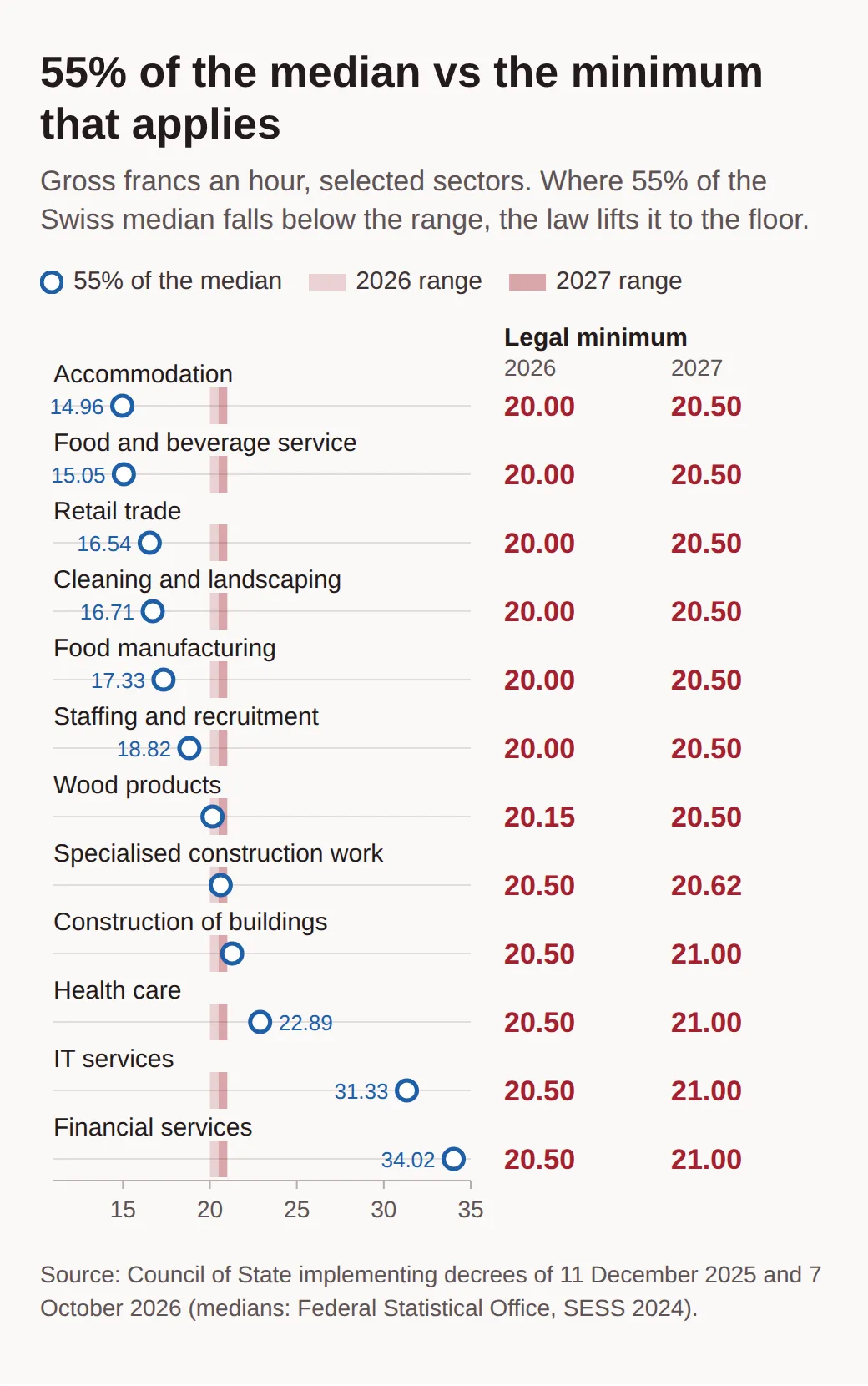
The chart shows why the range matters more than the percentage. In accommodation, 55% of the median would be CHF 14.96, in food and beverage service 15.05 and in retail 16.54: for these sectors the law lifts the minimum to 20.00. At the other end, 55% of the median is 31.33 in IT services and 34.02 in finance, but the legal minimum stays at 20.50. The minimum wage, in other words, is a social floor. It doesn't tell you what people usually earn in a sector.
To know which row applies to you, you need your employer's NOGA code. The Federal Statistical Office assigns it according to the company's activity, and your employer knows it. If you'd rather not ask, you can look up the activity in the FSO's KUBB search tool and then find the sector on the Canton's minimum wage page, which also has a calculator that takes your weekly hours and a 13th salary into account. Like all the Canton's documents linked here, that page is in Italian, and it already shows the 2027 figures, which are different.
2027 to 2029: three steps, then inflation
On 20 April 2026 Ticino's Grand Council passed an amendment to the law, published in the official bulletin of laws on 26 June, which takes effect on 1 January 2027. It came out of a compromise reached in the parliament's Management and Finance Committee and is, in effect, the counter-proposal to the popular initiative "Per un salario minimo sociale" (for a social minimum wage). The amendment raises the range over three years and suspends inflation indexing until 2030, when the Canton will make up for the price rises of 2027 to 2029 in one go.
The 2027 decree, signed by the Council of State on 7 October 2026, already applies the new range. Of the 87 sectors, 30 move to CHF 20.50, 45 to 21.00 and 12 sit in between. Hotels, restaurants and retail rise from 20.00 to 20.50; construction of buildings, health care, IT and finance from 20.50 to 21.00. Here is what that means per month, full time at 42 hours a week and 12 salaries a year:
| Year | Hourly range | Monthly minimum at 42 hours |
|---|---|---|
| 2026 | CHF 20.00–20.50 | CHF 3,637.20–3,728.13 |
| 2027 | CHF 20.50–21.00 | CHF 3,728.13–3,819.06 |
| 2028 | CHF 21.00–21.50 | CHF 3,819.06–3,909.99 |
| 2029 | CHF 21.75–22.25 | CHF 3,955.46–4,046.39 |
We used the Canton's method, which we cover in the next section. For 2028 and 2029 the law only sets the range: each sector's figures will come with the decrees for those years.
Who benefits? The Management and Finance Committee's report estimates, from 2024 wage data, that about 23,000 people are paid less than CHF 22.25 an hour: just over 15,000 cross-border commuters and about 8,000 residents. The largest group works in restaurants and catering, with 2,702 people, followed by other manufacturing, cleaning and landscaping, and wholesale and retail trade. For all of them, the January 2027 payslip is the first thing to check, and the check starts with a simple sum.
From monthly to hourly: the Canton's formula
The law only talks about francs per hour, so every salary has to be converted. The FAQ of the labour market surveillance office (Ufficio per la sorveglianza del mercato del lavoro) gives two formulas. With 12 salaries a year: the monthly salary divided by 4.33, the average number of weeks in a month, then divided by your weekly hours. With a 13th salary: the annual salary divided by 52 weeks, then divided by your weekly hours. The result must reach at least your sector's minimum.
Take an offer of CHF 3,600 gross a month for 42 hours at a clothing manufacturer, a sector at 20.00 in 2026 and 20.50 in 2027. With 12 salaries that's 3,600 divided by 4.33 divided by 42, or CHF 19.80 an hour: already below the minimum in 2026, by CHF 37.20 a month. With 13 salaries the same monthly pay comes to CHF 46,800 a year, divided by 52 and by 42, or 21.43 an hour. That's legal in 2026 and 2027, and still in 2028 if the sector stays at the bottom of the range as it does now. In 2029 it's no longer enough, because the bottom of the range will be 21.75. So the 13th salary makes the difference, but the Canton only counts it if the contract provides for it: the salary has to be paid every month, and only the 13th may come later.
Part-time work follows the same rule: every hour must be paid at least the minimum, so what counts is the hourly rate, not the total. If you're paid by the hour, you also get holiday pay on top, 8.33% with four weeks of holiday or 10.64% with five, plus 3.60% for nine public holidays. The Canton's example uses CHF 20.50: with these added it comes to 23.01 an hour, or 22.95 if both percentages are calculated on the base rate, and both methods are allowed.
Two details if you work flexible hours. On a fixed monthly salary the inspectorate looks at the hours in your contract, and extra or missing hours stay in your hours balance. But if it turns out the extra hours are never made up, the check uses the hours you actually worked. And overtime under the federal Labour Act must be paid at least 25% extra or made up with time off.
Bonuses, board and lodging: what counts towards the minimum
Until 31 December 2026, only fixed pay counts. The regulation now in force requires a salary that is "fixed, guaranteed and predictable" and accepts commission, bonuses, gratuities and benefits only on top of the minimum. The November 2024 FAQ, which applies for 2026, adds that supplements for night, public holiday, overtime or shift work come on top of the minimum and don't replace it.
From 2027 the rule widens. The amended law says the check covers all pay subject to AHV/AVS contributions (old-age and survivors' insurance), and the new regulation of 8 July 2026 lists in an annex what counts and for how much.
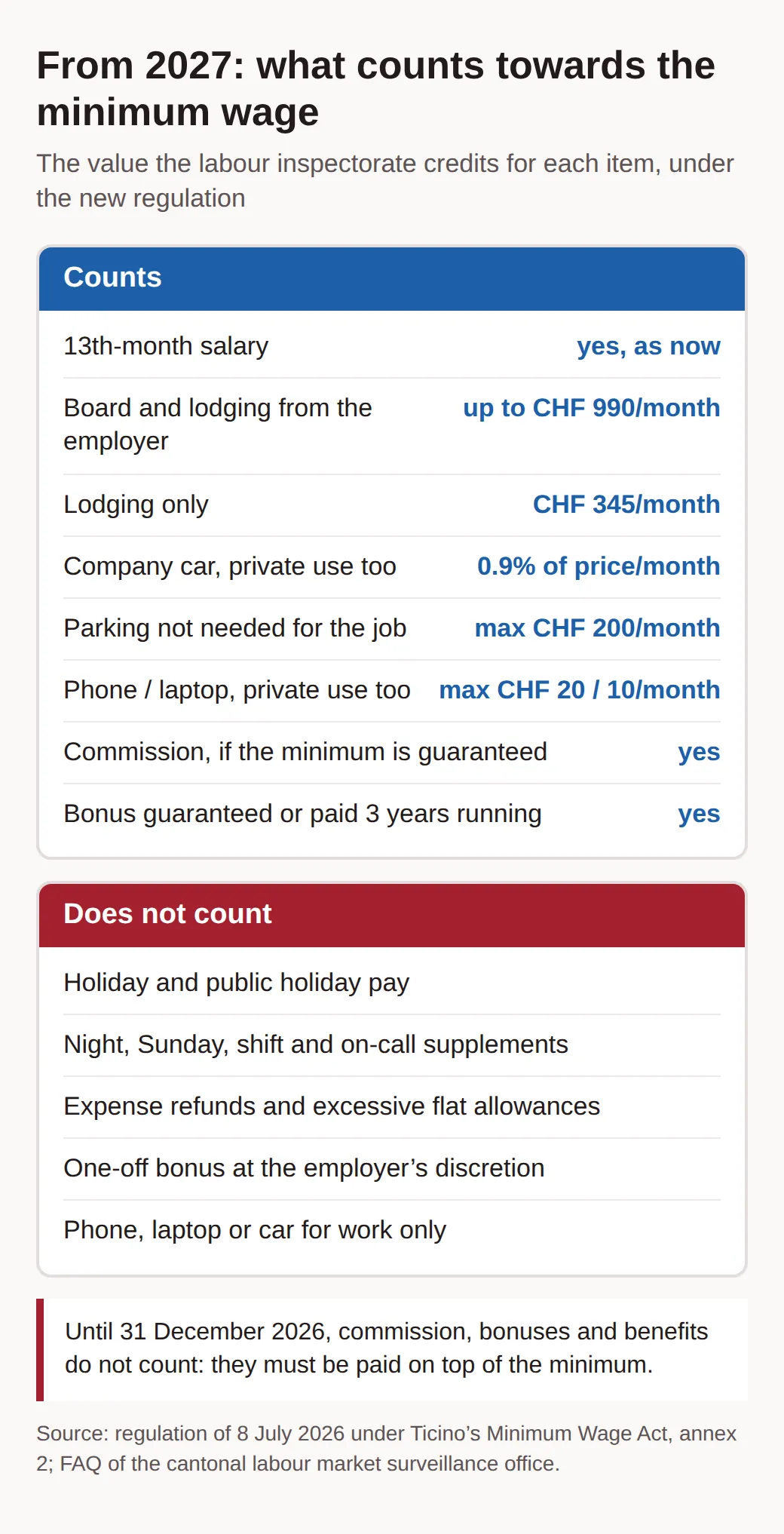
If your employer provides board and lodging, this change matters. The regulation credits CHF 3.50 a day for breakfast, 10.00 for lunch, 8.00 for dinner and 11.50 for lodging, up to CHF 990 a month for full board and lodging. From 2027 that amount can cover part of the minimum, so the cash pay can be lower without breaking the law. A bonus counts if the contract guarantees it, or if it has been paid for at least three years in a row without the employer declaring it voluntary each time. Commission counts only if the contract guarantees the minimum anyway.
Holiday and public holiday pay stay out, because they're an entitlement, and so do supplements that compensate for extra strain: nights, Sundays, shifts, on-call duty. Expense refunds and a one-off bonus at the employer's discretion stay out too. If part of your pay is in kind, it's worth having its value written into your contract. The next step is working out whether the cantonal law really applies to you, or a collective agreement does.
Does the minimum wage apply under a collective agreement?
In 2026, often not. The law in force today excludes jobs covered by a generally binding collective labour agreement (CCL in Italian), meaning one the state has extended to every company in the sector, or by a collective agreement that sets a mandatory minimum wage. That second clause created a loophole. According to the committee's report, an organisation set up in 2021 signed collective agreements at CHF 16 an hour, CHF 2,890 gross a month full time, well below the legal minimum.
From 1 January 2027 the principle is reversed: the cantonal minimum takes priority over collective agreements with lower minimums too, as it already does over standard employment contracts (CNL in Italian). There are three exceptions.
- Collective agreements signed before 1 January 2026 have until 31 December 2029 to raise wages to the legal level.
- The minimums in standard employment contracts in force on 1 January 2026 remain valid until the standard contract expires, even if they're below the new range.
- A company in serious crisis can ask for an exemption of up to three years, renewable, but only under a collective agreement signed before 2026.
The exemption is narrow by design. The employer has to show that the company faces substantial, proven job losses, the request must be signed by all parties to the collective agreement, the tripartite commission decides by a two-thirds majority of those present, and every approval is published in full in the Official Gazette. The committee's report specifies that the exemption is meant for company agreements, not those covering a whole sector.
Which agreements will have to adjust? The Council of State, answering the committee, lists, among the cantonal generally binding agreements, some categories in gardening, retail, cleaning and facility management, and road haulage. Among the federal agreements applied in Ticino it names staff leasing, hairdressing, and hotels and restaurants, especially small businesses, where the normal week is 45 hours and the hourly pay works out lower. The comparison is with the 2029 threshold of CHF 22.25, and the government's list isn't complete: the Canton has no list of all the collective agreements in force and only examined the generally binding ones.
Alongside collective agreements, Ticino has nine standard employment contracts, which the Canton imposes where it has found repeated wage abuse. They often sit above the minimum. According to the list of 2026 minimums, an IT worker in category a must get at least CHF 21.82 an hour, and an unqualified shop assistant outside the cantonal retail agreement 20.50, while the legal minimum in those sectors is 20.50 and 20.00. The higher figure always applies.
A note on Bern. On 19 June 2026 the federal parliament passed an amendment to the law on generally binding collective agreements that would give these agreements' minimums priority over cantonal ones. Cantons that already have their own minimum would be able to keep it, though, according to Parliament's report (in Italian) on the National Council vote. Unions and the left have submitted over 100,000 signatures for a referendum against the amendment, the Swiss-Italian broadcaster RSI reports. Until the federal amendment takes effect, the cantonal rules described here apply in Ticino.
Who it covers and who is left out
The law covers every job carried out in the canton, including temporary agency staff and workers posted by foreign companies. Your nationality doesn't matter, and neither does where you live. The law's list leaves out:
- apprentices;
- under-18s doing light work;
- au pairs;
- interns, if the internship meets the regulation's criteria;
- people whose reduced capacity to work is recognised by a social insurance scheme or by social assistance;
- family members working in a family business;
- people taking part in state-funded social schemes, such as reintegration programmes;
- farm staff.
Two items raise the most questions. An internship is excluded only if it meets at least one of the regulation's six basic criteria, for example a three-way contract with the school, a reintegration internship of no more than six months or a graduate internship in the year after graduating, and at least eight of the ten training criteria: written goals, a contact person, review meetings, a final certificate, no promise of a job. In 2025 the inspectorate found 13 of the 136 internships it checked to be irregular. As for family businesses, the FAQ makes clear that a company limited by shares (SA) or a limited liability company (Sagl) isn't one: there only the partners who make the decisions are excluded, while family members they employ are entitled to the minimum.
Who checks, and what employers risk
Checks are done by the cantonal labour inspectorate (Ufficio dell'ispettorato del lavoro). On request, the employer must hand over every document showing the minimum is paid and let inspectors onto the premises. If the documents are missing, it's up to the employer to prove it complies.
According to the tripartite commission's statement of 11 February 2026, in 2025 the inspectorate checked 4,164 companies with 17,667 employees. It found 186 companies in breach, 4.5%, with 463 people underpaid. The commission says most cases came from errors of calculation or judgement and that the differences were almost always paid back. Of the 75 reports received, about a third led to a sanction.
The penalty is tied to the amount saved: 160% of the difference between the wage owed and the wage paid, up to CHF 30,000, and it can drop to 50% if the employer pays the arrears. In our clothing example, CHF 37.20 a month for a year comes to 446.40 in arrears and a penalty of 714.24. Anyone who breaks the law systematically for profit, or obstructs checks, risks a criminal fine of up to CHF 40,000. The penalty goes to the state, though. Your arrears are your own claim, and you have to ask for them.
If your payslip shows less than the minimum
The first step is to redo the sum with the formulas above, using the right sector and every hour you worked. If the result is still short, ask for the difference in writing, with a deadline. The letter can be brief:
Dear Sir or Madam, my contract provides for CHF 3,600 gross a month, paid 12 times a year, for 42 hours a week, which is CHF 19.80 an hour. The 2026 minimum wage for the sector is CHF 20.00 an hour. Please pay me at least CHF 3,637.20 a month from now on, and the difference since my first day of work, within thirty days. Kind regards.
If no answer comes, there are two routes, and you can take both. The first is the online report to the labour market surveillance office: your name and contact details are optional, and the office says it doesn't disclose reporters' details. A report can trigger a check, but it won't get your money back.
The second route is a civil claim, described in the tripartite commission's guide. First comes a conciliation attempt: before the justice of the peace (Giudice di pace) for claims up to CHF 5,000, and before the district court judge (Pretore) above that. The competent court is the one where the employer is based or where you usually work. Wage claims lapse after five years, so you can act even after leaving the job, and up to CHF 30,000 there are no court fees. Unions and legal protection insurers can help with the paperwork.
Before you sign, and in January
Before you sign a contract in Ticino, ask for three things in writing: the gross pay, the weekly hours and the number of salaries a year. With these and the employer's NOGA code, the check takes two minutes. Ask too whether the company applies a collective agreement, and which one, because in 2026 it can move the floor up or down, and a collective agreement signed before 2026 can stay below the legal minimum until the end of 2029.
Then mark a date: the January 2027 payslip. It's the first with the new figures, and the first in which board, lodging and guaranteed bonuses can count. If you're a cross-border commuter, remember the minimum is gross: to get to your net pay you also need the taxes under the new agreement. Still, the minimum wage is only a floor. Many offers in Ticino pay well above it, and it pays to compare them once you've done your own sums.
Common questions
- Does the Ticino minimum wage apply to cross-border workers?
- Yes. The law covers every job done in the canton, whatever the worker's home address. In fact, according to the Canton's figures, about two thirds of the people paid less than CHF 22.25 an hour are cross-border commuters. It also covers temporary agency staff and workers posted by foreign companies.
- Is the Ticino minimum wage gross or net?
- Gross. Every figure in this article is before social insurance contributions and, if you pay it, withholding tax. What reaches your bank account is therefore lower than the minimum, and that is normal.
- Can I agree in writing to a salary below the minimum wage?
- No. The law says its rules cannot be waived to the worker's disadvantage. Signing a contract with lower pay does not cancel your right to the difference, which you can claim for five years.
- Does a company based outside Ticino have to pay the Ticino minimum wage?
- Yes, for work done in Ticino. The regulation explicitly includes workers posted from EU countries or other states. In 2025 the inspectorate checked 606 foreign employers active in Ticino for less than 90 days and sanctioned 67 of them.
- Does the minimum wage apply during probation or on a fixed-term contract?
- Yes. The law lists its exceptions one by one, and neither the probation period nor a fixed-term contract is among them. All that matters is your employer's sector and whether you fall into one of the excluded groups, such as apprentices or interns.
More posts
All posts
G permit in Ticino: requirements, renewal and changing jobs
Ticino G permit in 2026: who qualifies, where you can live, the weekly return rule, applying online, fees, five-year renewal and changing employer.

Ticino B permit: requirements, fees and G permit compared
B permit in Ticino for EU citizens: who qualifies, applying and fees at the Migration Office, tax and health insurance as a resident, the C after 5 years.

Cross-border family allowances: who pays what in 2026
Family allowances for cross-border workers in Ticino: when INPS pays first, what Switzerland adds, how to apply and how many years of arrears you can claim.