Ticino B permit: requirements, fees and G permit compared

Before you move
If you're an Italian citizen with an employment contract in Ticino lasting at least a year, you're entitled to a B permit: it lasts five years, costs CHF 75 and you apply for it online to the Migration Office before you start work. Compared with the G permit, everything that depends on where you live changes: tax, health insurance, unemployment benefits and, after five years, the C permit.
The move pays off if you're a new cross-border worker today and also pay Irpef, Italy's income tax. For an old cross-border worker, on the other hand, the tax bill stays the same and Ticino's health insurance premiums come on top, second in Switzerland only to Geneva's. Below you'll find the rules, the canton's fees, our calculations for three salaries and the points where a move tends to get stuck, almost always on the Italian side.
Who is entitled to a B permit as an EU worker
The right comes from the Agreement on the Free Movement of Persons (official text in Italian), Article 6 of its Annex I. An EU national working for an employer in Switzerland in a job lasting a year or more receives a residence permit valid for at least five years, which is renewed automatically. The State Secretariat for Migration (SEM) puts it in practical terms: you need an employment contract of at least twelve months or an open-ended one.
With a shorter contract you get a different permit. Between three months and a year you receive an L permit, valid for as long as the contract. Under three months per calendar year you don't need a permit at all: a notification is enough.
The agreement also limits what the canton can ask for. Two documents are enough for the permit: the one you entered Switzerland with, meaning an identity card valid for travel abroad or a passport, and a confirmation of employment or an employment certificate from your employer. And the paperwork can't stop you from starting work: Article 6 says the formalities must not hinder the immediate performance of the employment contract.
The B EU/EFTA permit is valid throughout Switzerland, as the Migration Office's notes for B permit holders (Ufficio della migrazione, in Italian) point out. With a B permit you can change employer, job or place of work, and switch to self-employment. Up to this point, the B and the G look alike. The real difference lies in where you live, and it starts with the application.
How to apply for a B permit in Ticino
Since 3 August 2026 all permit applications go through the canton's digital procedure: an online form, documents uploaded, no copies by post. The Population Section's news page (Sezione della popolazione, in Italian) announced the change. At the end you get a receipt or a substitute declaration confirming that your application has been sent.
Who applies depends on where you are. If you still live abroad, the canton's page for people arriving from abroad says your employer files the application, and when you arrive in Ticino you complete your residence formalities with the form you've received. If you're already in Switzerland, you apply yourself, before you start work, as the page on the new B permit for EU/EFTA nationals explains (both in Italian). If you already hold a G permit and are moving while keeping the same job, ask first which form to use: the contact centre answers on +41 91 814 55 00, Monday to Friday, 8 am to 12 noon and 1.30 to 5 pm.
Then there's the municipality. The Foreign Nationals and Integration Act requires anyone who needs a permit to register with the authority at their place of residence as well; in Ticino you report your arrival to the residents' registration office (Ufficio controllo abitanti) of the municipality you're moving to. In Lugano, the arrival notification is made at a Puntocittà office or through the Online Desk. Each municipality sets its own deadlines and documents, so ask yours before you move.
One detail matters for many Italians. The canton points out that since 3 August 2026 the old paper Italian identity card is no longer valid for travel abroad, whatever expiry date it shows. If you still have one, use your passport or replace it with the electronic card before you start the application.
B and C permit fees
The fees for EU/EFTA nationals are published on the B permit page. These are the main ones:
| Procedure | Adults | Under 18 |
|---|---|---|
| Issuing a B permit | CHF 75 | CHF 40 |
| Renewal | CHF 75 | CHF 40 |
| Change of status | CHF 75 | CHF 40 |
| New address or municipality | CHF 40 | CHF 30 |
| Duplicate | CHF 60 | CHF 40 |
| Switching from B to C | CHF 115 | CHF 40 |
For a new address, a duplicate or other changes, add CHF 15 if a new photo and signature are needed, and for a new address another CHF 10 to print the card. If your application is left incomplete, the reminder by registered post costs a further CHF 20. The fee for switching to a C permit comes from the C permit page (in Italian).
Once you have the permit, the deadlines are few but strict. Any change of address, municipality, marital status or family must be reported within 14 days. You must apply for renewal at least 14 days before the permit expires. A permanent departure must be announced at least 14 days in advance. And the permit lapses after an uninterrupted stay abroad of more than six months. The paperwork is cheap. The real bill comes from tax.
Tax as a resident: the old cross-border worker's table
With a B permit you're still taxed at source, as with a G permit: your employer deducts the tax every month. What changes is the table. The cantonal directive on tax at source (in Italian) puts residents with a B permit and old cross-border workers in the same group: tables A, B, C and H. New cross-border workers use tables R, S, T and U instead, set at roughly 80% of the others because the cross-border workers agreement doesn't allow Switzerland to go higher, but they then pay Irpef in Italy as well.
We took the 2026 rates from the official file of tax-at-source rates published by the Federal Tax Administration. For a single person with no children earning CHF 5,500 a month with a 13th-month salary, table A0 withholds 10.1%, or CHF 7,221.50 a year. Table R0 for a new cross-border worker withholds 8.0%. On the same salary, a resident therefore pays more in Switzerland than a new cross-border worker, but nothing in Italy.
As a resident you also have an option that new cross-border workers no longer have: the subsequent ordinary assessment, meaning a full tax return with the deductions the tables don't take into account. It's compulsory if your gross employment income is over CHF 120,000 a year, or if you have other income or assets above certain thresholds. Below that, you can ask for it by 31 March of the following year. Be careful, though: according to the directive, the request can't be withdrawn and also applies to the following years.
For families there's a change that works in favour of the B permit. On 15 September 2026 the Grand Council approved an amendment that reserves the child deduction in cantonal and municipal tax for people who live in Switzerland; according to the dispatch on the 2027 budget (in Italian), it is due to come into force on 1 January 2027. We explain what this means for cross-border workers in our article on cross-border workers' tax under the new agreement. Tax, though, is only half the bill.
Health insurance: paying Ticino's premiums
Anyone who takes up residence in Switzerland must take out health insurance within three months. That's Article 3 of the Health Insurance Act (in Italian). If you sign up in time, cover starts on the day you move. If you sign up late, it starts on the day you join and, if the delay isn't justified, you pay a premium surcharge. Cross-border workers can choose between Swiss health insurance and the Italian national health service; with a B permit that choice is gone, as we explain in our article on cross-border workers' health insurance.
Ticino's premiums are high. In the table of average cantonal premiums for 2027 published by the Federal Office of Public Health (FOPH), an adult aged 26 or over pays an average of CHF 603.60 a month in Ticino, against CHF 487.60 for Switzerland as a whole; only Geneva is more expensive, at CHF 610.60. A young adult aged 19 to 25 pays CHF 418.40, a child CHF 153.20. These averages include high deductibles and alternative insurance models: your own premium depends on the insurer, the deductible and the model. For a single person they still come to about CHF 7,240 a year.
One year's bill, before and after the move
We put tax and premiums together for three salaries, again for a single person with no children. The new cross-border worker's Irpef is calculated as in our tax article: a €10,000 allowance, the 2026 brackets and the credit for Swiss tax.
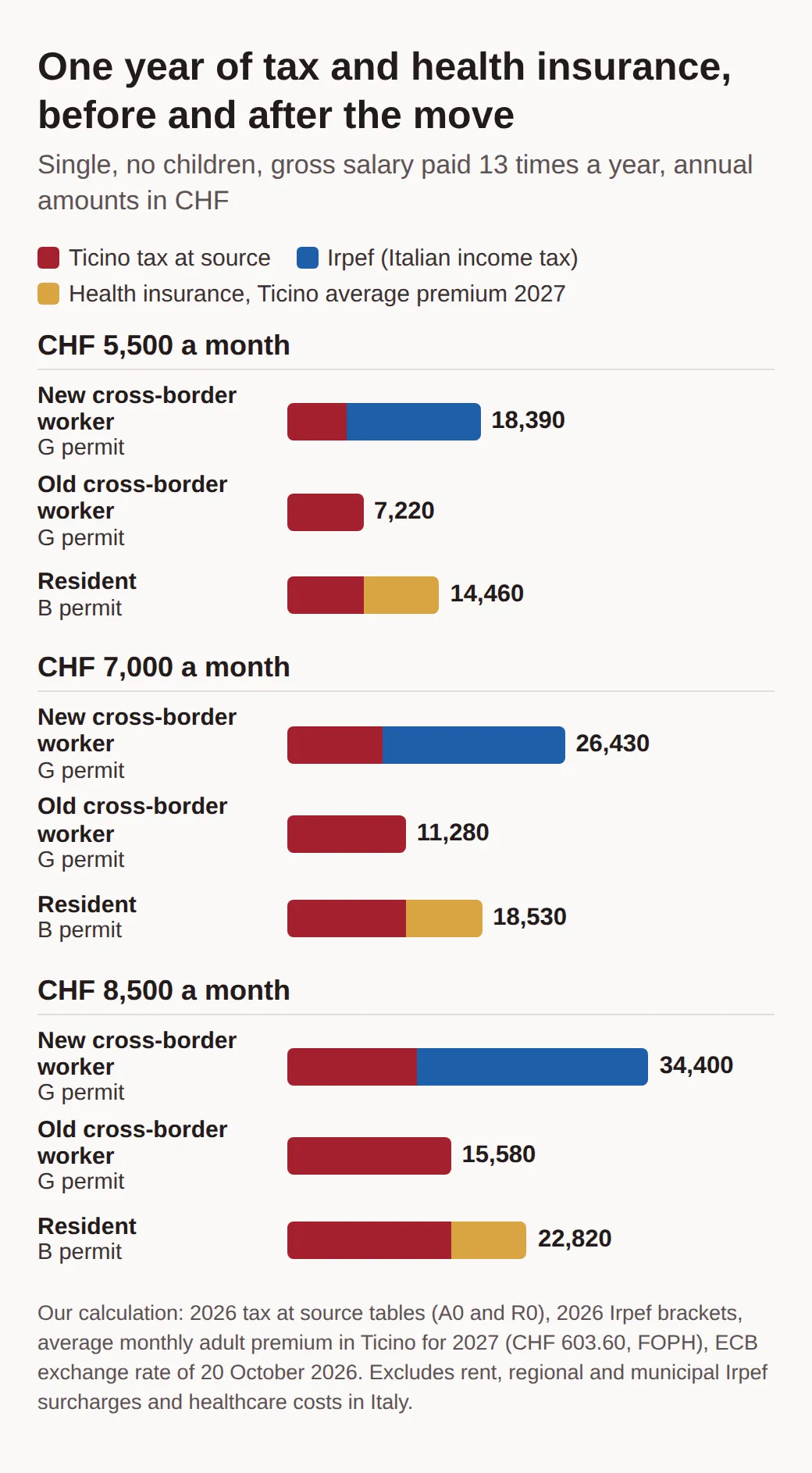
For a new cross-border worker, moving saves about CHF 3,900 a year on CHF 5,500 a month, about CHF 7,900 on CHF 7,000 and about CHF 11,600 on CHF 8,500. The higher the salary, the more you save by no longer paying Irpef. An old cross-border worker gets the opposite result: they already pay tax only in Switzerland, on the same table, so the move adds about CHF 7,240 in premiums without taking anything away.
The chart leaves out an item that can outweigh all the others: rent in Ticino, which can eat up the saving. It also leaves out the regional and municipal Irpef surcharges, which depend on the Italian municipality, and healthcare costs in Italy. And the tax saving only holds if Italy accepts that you have really left.
What happens in Italy when you move
Anyone moving abroad must register with the Registry of Italians Resident Abroad (AIRE) within 90 days. That's set out on the Italian Foreign Ministry's AIRE page (in Italian): you apply online through the Fast It portal, it's free, and if you don't apply you risk an administrative fine.
AIRE on its own isn't enough. Since 2024 Italian law treats as resident anyone who, for most of the year, has their residence or domicile in Italy or is physically present there. And by domicile it means the place where your personal and family life is mainly based. Circular 20/E of 2024 from the Italian Revenue Agency (in Italian) gives an example that could have been written for Ticino: someone who registers with AIRE and works abroad, but keeps a home in Italy available with the utilities connected and goes back there at weekends, may still be domiciled in Italy.
If you move to Lugano on your own while your spouse and children stay in Varese, you're in the most delicate position. For the Italian tax authorities, family ties count for more than a rental contract. If Italy still considers you resident, it taxes your Swiss salary and credits the tax already paid in Ticino against it, and the saving in the chart shrinks a lot.
Two things work in your favour. Since 1 January 2024 Switzerland is no longer on Italy's 1999 list of countries with preferential tax regimes, as the same circular confirms: for people moving to Ticino, the presumption that they stayed resident in Italy until proven otherwise no longer applies. And the tax treaty between Italy and Switzerland splits the year of the move: from the day after you move for good, you're resident only in Switzerland. For old cross-border workers, though, the real question is a different one.
When an old cross-border worker moves
An old cross-border worker pays tax only in Switzerland thanks to the transitional regime in Article 9 of the 2020 cross-border workers agreement (in Italian). It covers anyone who worked as a cross-border worker between 31 December 2018 and 17 July 2023. The additional protocol states that the status stays even after breaks in employment or a change of employer, as long as the person still meets the definition of a cross-border worker: living in a municipality within 20 km of the border and going home every day.
With a B permit you no longer meet that definition. As long as you live in Ticino, that's not a problem: you pay on table A as before, and Italy taxes nothing. The question arises if one day you move back to Italy and start commuting across the border again. The canton's information sheet (in Italian), at question 3.12, answers a similar case: someone who was a cross-border worker during the period, moved outside the 20 km zone and comes back years later stays in the transitional regime, because having been one during that period is enough. The case of someone who lived in Switzerland in the meantime isn't covered anywhere.
If you think you might go back, ask the tax-at-source office (Ufficio delle imposte alla fonte) for written confirmation before you move, describing your case. A wrong answer can be worth thousands of francs a year, as the chart shows. If you stay, sooner or later you face the next step: the C permit.
The C permit after five years, only if you live here
Italian citizens are entitled to a C permit after five years of regular, uninterrupted residence in Switzerland. This right doesn't come from the free movement agreement but from a settlement agreement between Italy and Switzerland.
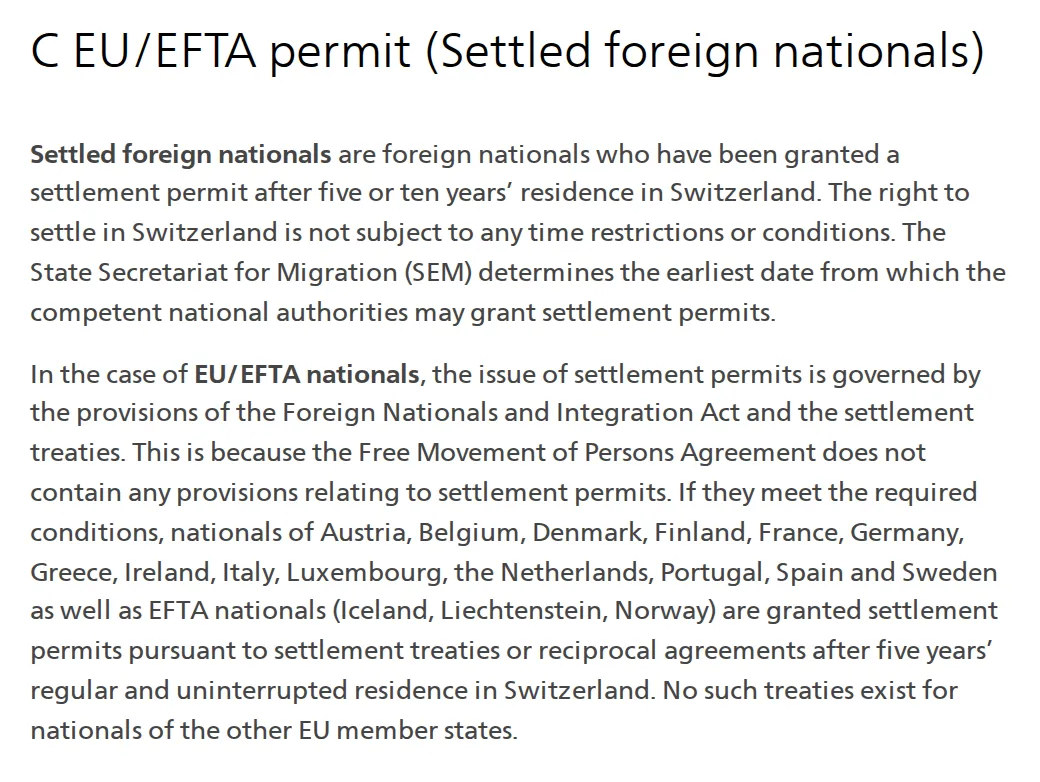
The SEM's directives on foreign nationals (in Italian), updated in June 2026, explain where it comes from: a declaration from 1934, referred to in the 1964 agreement on the emigration of Italian workers to Switzerland. The general rule in the Foreign Nationals and Integration Act is ten years.
Years on a G permit don't count. The law only counts residence on an L or B permit, and a cross-border worker by definition lives abroad. If you've worked in Mendrisio on a G permit for ten years and then move, you start from zero: the five years begin on your first day as a resident.
Five years aren't enough on their own. The directives make clear that even with a settlement agreement, you must be integrated and there must be no grounds for revocation. The Ordinance on Admission, Period of Stay and Employment (in Italian) requires proof of the local language: at least A2 spoken and A1 written. In Ticino, the Population Section points out, native Italian speakers don't need a certificate. You must apply at least 14 days before your B permit expires, and the switch costs CHF 115.
Your tax changes with the C permit too. According to the tax-at-source office's FAQ (in Italian), tax is no longer deducted from your pay from the month after the permit is issued, and ordinary taxation applies to the whole year in which you get the C. Before you reach that point, though, the B permit can also come to an end.
If you lose your job or go back to Italy
The B permit doesn't lapse on the day your contract ends. The Agreement prohibits withdrawing it just because the holder no longer works, if they are involuntarily unemployed and registered with the employment office, or unable to work because of illness or an accident. The Foreign Nationals and Integration Act does set limits, though. If you lose your job through no fault of your own in the first twelve months, your right of residence ends six months later, or when your unemployment benefit ends if that lasts longer. In this first case you have no right to social assistance until your right of residence ends. After the first twelve months, the right ends six months after your job ends or, if your benefit lasts longer, six months after the benefit ends.
As a resident you claim Swiss unemployment benefit, not Italy's NASpI. That's a clear difference from cross-border workers, which we explain in our article on unemployment for cross-border workers. The SEM adds that at the first renewal the permit can be limited to one year if you have been involuntarily unemployed for more than 12 consecutive months.
If you decide to go back to Italy, you must announce your departure at least 14 days in advance. If you then start working in Ticino again as a cross-border worker, you apply for a new G permit as you did the first time, and your tax status needs checking again, as described above. If you leave without reporting your departure, you lose the B permit anyway after six months.
Before you decide to move
The B permit itself is the easy part: CHF 75, a contract of at least a year and an online application. The decision is made elsewhere. First redo the chart's calculation with your own salary and family situation, then add the real rent for the flat you want and the health insurance premium you'll choose. If you're a new cross-border worker, the margin grows with your salary: on CHF 8,500 a month it's almost CHF 1,000 a month before rent. If you're an old cross-border worker, the move starts at a loss of about CHF 600 a month in premiums.
Then look at your family the way the Italian tax authorities will. If your spouse and children stay in Italy, the move may not hold up, and the saving goes with it. If the whole family moves, put three deadlines in your diary: the permit application and registration with the municipality when you move, health insurance within three months and AIRE within 90 days. Five years later comes the C permit.
Common questions
- Can I keep my house in Italy if I get a Swiss B permit?
- As far as Switzerland is concerned, yes: the B permit requires you to actually live in Ticino, not to sell your house in Italy. The risk is on the Italian side. The Italian Revenue Agency mentions exactly the case of someone who registers with AIRE but keeps a home with the utilities connected and goes back there at weekends: for the Italian tax authorities, that person may still be resident in Italy.
- Can my spouse move to Ticino with me and work there?
- Yes. The Agreement on the Free Movement of Persons gives the spouse and the children under 21 of an EU worker the right to live with them, whatever their nationality, and to work. You need housing considered normal for a worker in the region. Their permit is valid for as long as yours.
- Do I get a B permit with an eight-month contract?
- No. With a contract of between three months and a year, an EU national gets an L short-term permit, valid for as long as the contract. The five-year B permit comes with a contract of at least 12 months or an open-ended one. For less than three months per calendar year, an online notification is enough.
- Is a B permit issued in Ticino valid in Zurich?
- Yes, the B EU/EFTA permit is valid throughout Switzerland, so you can work for an employer in another canton. If you move your residence to another canton, though, you must register there within 14 days, and the new canton issues your permit. Moving to Ticino from another canton costs CHF 50.
More posts
All posts
Cross-border workers' health insurance: LAMal or SSN in 2027
Live in Italy and work in Ticino? You have three months to choose LAMal or the SSN. 2027 premiums, Italy's health tax, family rules and the cost of a birth.
Cross-border family allowances: who pays what in 2026
Family allowances for cross-border workers in Ticino: when INPS pays first, what Switzerland adds, how to apply and how many years of arrears you can claim.

Swiss pension for cross-border workers: AVS, LPP, Italy's 5%
Cross-border workers living in Italy: what your AVS pension is worth, where to claim it, LPP annuity or lump sum, Italy's 5% tax and the Swiss tax refund.