Cross-border workers' health insurance: LAMal or SSN in 2027

Before the deadline
If you work in Ticino and live in Italy, you have to take out Swiss health insurance under LAMal, unless you apply to stay in Italy's National Health Service (Servizio sanitario nazionale, SSN). The application goes to the Contributions Office in Bellinzona within three months of starting work. Miss the deadline and you stay in LAMal, and as a rule your choice also covers family members who don't work.
It's one of the first decisions you make as a new cross-border worker, and one of the few you can't put right later. In 2027 an adult living in Italy will pay CHF 307 to 509 a month for LAMal, depending on the insurer; a family of four will pay CHF 755 to 1,305. The SSN has no premium, but for old cross-border workers Italian law has brought in a contribution of up to €200 a month, which Lombardy wants to collect. Here we set the rules of the Federal Office of Public Health (FOPH) and the canton of Ticino next to the actual premiums for people living in Italy, and we look closely at one case that costs a family dearly: giving birth.
Who can choose between LAMal and the SSN
In Switzerland, health insurance follows the place of work. The FOPH page on cross-border commuters says it plainly: anyone working in Switzerland, as well as non-working family members, is required to take out Swiss health insurance. LAMal is the French and Italian name of that compulsory cover (KVG in German), and the obligation starts with your employment contract and ends with it.
Switzerland does, however, have special arrangements with its four neighbours. According to the information sheet of the Common Institution under the KVG, the body in Olten that handles these requests for several cantons, the option right belongs to cross-border workers who live in Germany, France, Italy or Austria and work in Switzerland as employees or self-employed. If you live in any other EU country, you have no choice: you must be insured in Switzerland. So if you live in Lombardy or Piedmont and hold a G permit, you have two routes.
The option doesn't apply by itself, though. In 2015 the Federal Supreme Court ruled (judgment 9C_801/2014) that being registered with the SSN isn't enough: you need a formal application for exemption. In the FOPH's words, "the so-called tacit exercise of this option does not have legal force". Its information letter of 20 April 2015 (in French) draws two conclusions. If you've never applied, the law treats you as subject to LAMal. And if you were exempted through a formal application, you can't go back to being insured in Switzerland. That's why the moment you choose matters.
The three-month deadline: when it starts
You have three months, counted from when you start working in Switzerland. The information sheet of Ticino's social insurance institute (Istituto delle assicurazioni sociali, IAS; in Italian) speaks of the three months following the start of the employment contract, while the sheet the Common Institution uses for Basel-Stadt counts them from the date your permit becomes valid. The safe course is to count from your first day at work and not to wait for the G permit to arrive in the post.
The canton adds a second case. If you worked in Ticino while living there and then move to Italy but keep your job, you have three months from the day you leave Switzerland. It's also clear about what happens if you do nothing: once the three months have passed without an application, your compulsory health insurance automatically stays in Switzerland.
The deadline works the other way too, and it's worth knowing. If you stay in LAMal, you must join a Swiss insurer within the same three months. According to the FOPH, if you don't, you can be assigned to an insurer automatically; if the delay isn't justified you pay a surcharge on your premium for late registration, and any treatment you had before joining is at your own expense. Letting the three months slip by still lands you in LAMal, just by the more expensive route.
There are two other moments when the choice reopens. When a child is born, if you're in LAMal you can apply to move to the SSN, again within three months (more on that below, because it comes at a price). And when you first retire with a Swiss pension there's a separate option, which you request from the Common Institution in Olten. Changing employer, on the other hand, isn't among the cases the canton lists: if you're counting on it, ask the Contributions Office to confirm first.
How to apply for an exemption in Ticino
In Ticino your application goes to the social insurance institute's Contributions Office, compulsory insurance section: Istituto delle assicurazioni sociali, Ufficio dei contributi, Settore obbligo assicurativo, Via Ghiringhelli 15a, 6501 Bellinzona. The list of cantonal offices updated by the FOPH in September 2026 (in Italian) gives the phone number +41 91 821 91 11 and the email address obbligo@ias.ti.ch. If you work in Graubünden or Valais, you go to the municipality instead.
To be exempted, you must prove that you're covered for illness both in Italy and during a stay in Switzerland or another EU country. That's the condition in Article 2 paragraph 6 of the Health Insurance Ordinance (KVV), cited in the Common Institution's sheet. The Common Institution's sheet for border workers, used for the cantons that delegate the check to it, asks for a copy of your permit and current proof of insurance cover, for you and for family members without work. Ticino handles applications itself, so ask Bellinzona which documents it wants. Italian is Ticino's official language, and a written request can be short:
Oggetto: richiesta di esenzione dall’obbligo LAMal (diritto di opzione)
Sono frontaliere, residente a [Comune] in Italia, impiegato dal [data] presso [datore di lavoro, località in Ticino]. Chiedo l’esenzione dall’obbligo di assicurazione malattie in Svizzera per me e per i miei familiari senza attività lucrativa [nomi e date di nascita], per restare assicurati nel Servizio sanitario nazionale italiano. Allego copia del permesso G e la prova dell’iscrizione al SSN.
In English, it says: you're a cross-border worker living in Italy, employed by a Ticino employer since a given date, and you request exemption from Swiss compulsory health insurance for yourself and your non-working family members so that you all stay in the SSN; you enclose your G permit and proof of SSN registration. Keep the exemption decision with your employment contract. Since the choice can't be changed, it's your proof that you chose in time, and you may need it many years later.
What LAMal costs if you live in Italy
If you live in Italy, you don't pay the premiums charged in Lugano or Mendrisio but those set for Italy. The FOPH page on EU/EFTA/UK premiums explains why: insurers must calculate a separate premium for each country, reflecting its costs, and only about a third of Swiss health insurers offer this cover. For Italy, the official 2027 premium overview, published in October (in German, French and Italian), lists 14 insurers.
The gaps are wide. In 2027, without accident cover, an adult will pay from CHF 306.90 a month (Helsana) to CHF 509.40 (Visana), with a median of about CHF 434. For a child the range is CHF 70.60 to 203.70. If you start work before January, you pay the 2026 premiums until December, and for an adult they're the same or lower at every insurer: CHF 279 to 487.20. We used premiums without accident cover because employees are normally already insured against accidents through their employer; with accidents included the premium goes up by a few dozen francs, from CHF 306.90 to 330, for example.
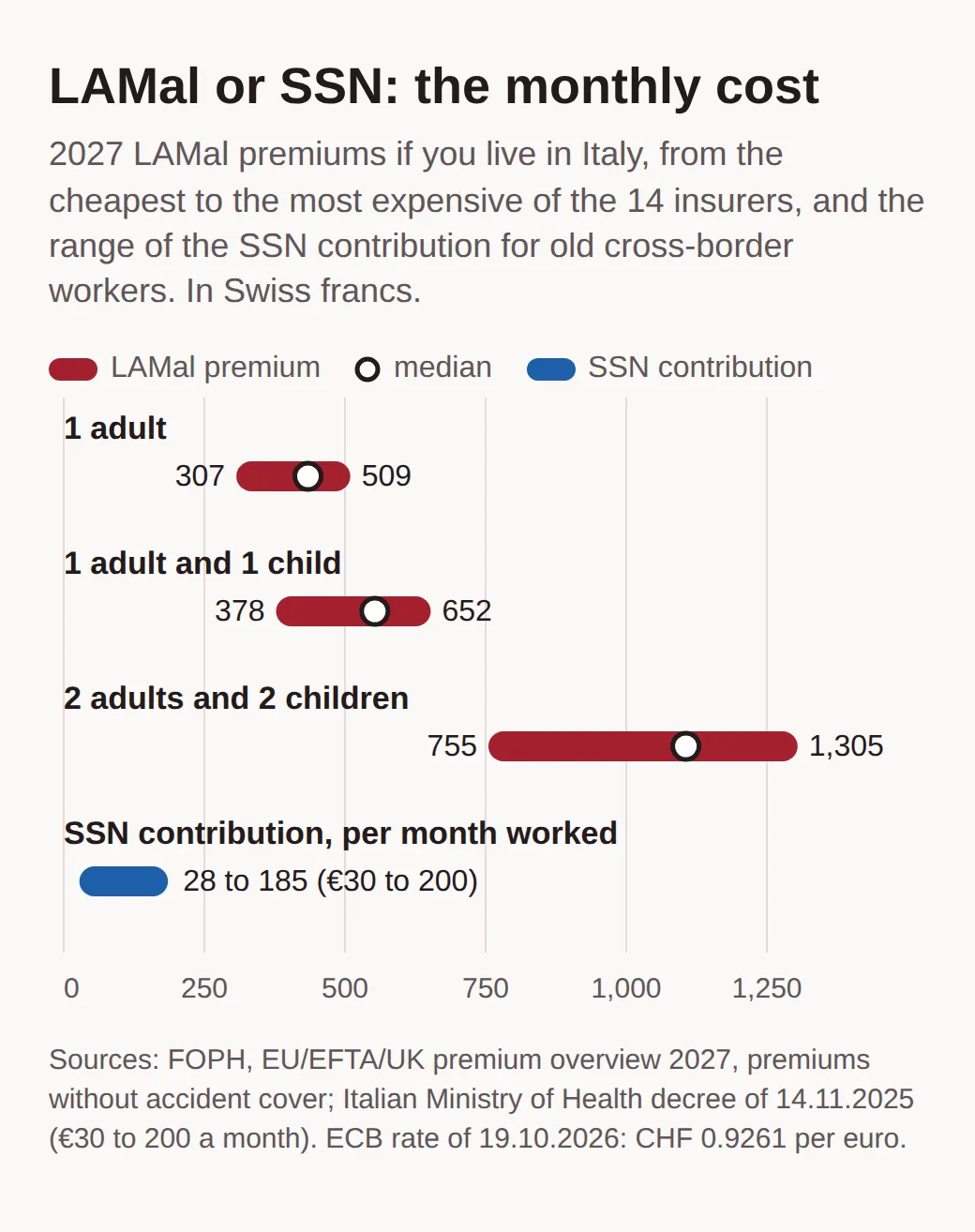
For a family the bill multiplies, because LAMal charges per person and, in the most common case, everyone is with the same insurer. In 2027 two adults and two children will spend CHF 755 to 1,304.60 a month: with the cheapest insurer that's CHF 9,060 a year. On top of the premium comes your share of treatment costs, the annual deductible (franchise) and the co-payment: ask your insurer how it applies them to treatment in Italy.
There's help, too. Switzerland grants premium subsidies to people on low incomes insured under LAMal who live in the EU, and for cross-border workers, the FOPH adds, the canton where they work is responsible. Premiums change every year and the EU overview comes out in the autumn: before you pick an insurer, check the one for the year you'll be working.
Italy's "health tax": who owes the SSN contribution and how much
The SSN has no premium, but for some cross-border workers Italy has introduced a contribution. Italy's 2024 Budget Law (Law 213 of 2023, Article 1, paragraph 237) requires three groups to pay a share of SSN costs to their region of residence: old cross-border workers under Article 9 of the tax agreement who opted for the SSN, their dependent family members, and people living in Italy who work and stay in Switzerland while using the SSN. New cross-border workers, who already pay Italian income tax (Irpef), as we explain in our article on cross-border workers' taxes, aren't in the group of old cross-border workers.
The figures are set by the Italian Ministry of Health decree of 14 November 2025 (in Italian), published in Italy's Official Journal on 18 December 2025. Each year the regions and the Province of Bolzano set a rate of between 3% and 6% of the net salary earned in Switzerland, rising with income and the number of dependants, with a minimum of €30 and a maximum of €200 for each month worked. The amount can double if you don't pay or don't declare. The decree applies the contribution from 2024 onwards, and the money goes to health services in the border areas, first of all to doctors and nurses.
When it will actually be collected, though, is still unclear. In a press release of 30 June 2026, Ticino's cantonal government (Council of State) says that Lombardy is the only region to have shown it intends to apply the contribution, possibly backdated to 2024, and that it has asked Italy's Ministry of Economy to postpone it to 2027. The canton regards the levy as a tax that breaches the tax agreements and has suspended the transfer of CHF 50,221,177 of the 2026 compensation payments (ristorni) due to Lombardy. In April, Lombardy's regional minister Massimo Sertori had announced the minimum rate of 3%, according to RSI: €120 a month on €4,000 net.
Set against the premiums, the contribution stays lower even at its maximum. At the ECB reference rate of 19 October 2026, CHF 0.9261 per euro, the €200 cap is worth CHF 185, less than the CHF 306.90 the cheapest LAMal insurer charges a single adult in 2027. And the cap applies per month worked, not per person like the Swiss premium. If you chose the SSN years ago, the comparison is academic anyway: as we saw, once exempted you can't move back into LAMal to avoid the contribution.
Family members: who follows your choice
In almost every case, family members without work follow the cross-border worker's choice. The IAS sheet on dependent family members (in Italian), the one the FOPH also points to, distinguishes three situations. If you're the only one working, the whole family follows your choice: with the SSN everyone stays insured in Italy, with LAMal everyone is insured in Switzerland, with the same insurer. If your spouse works in Italy or receives an Italian pension, the children stay insured in Italy, and with LAMal only you are insured in Switzerland.
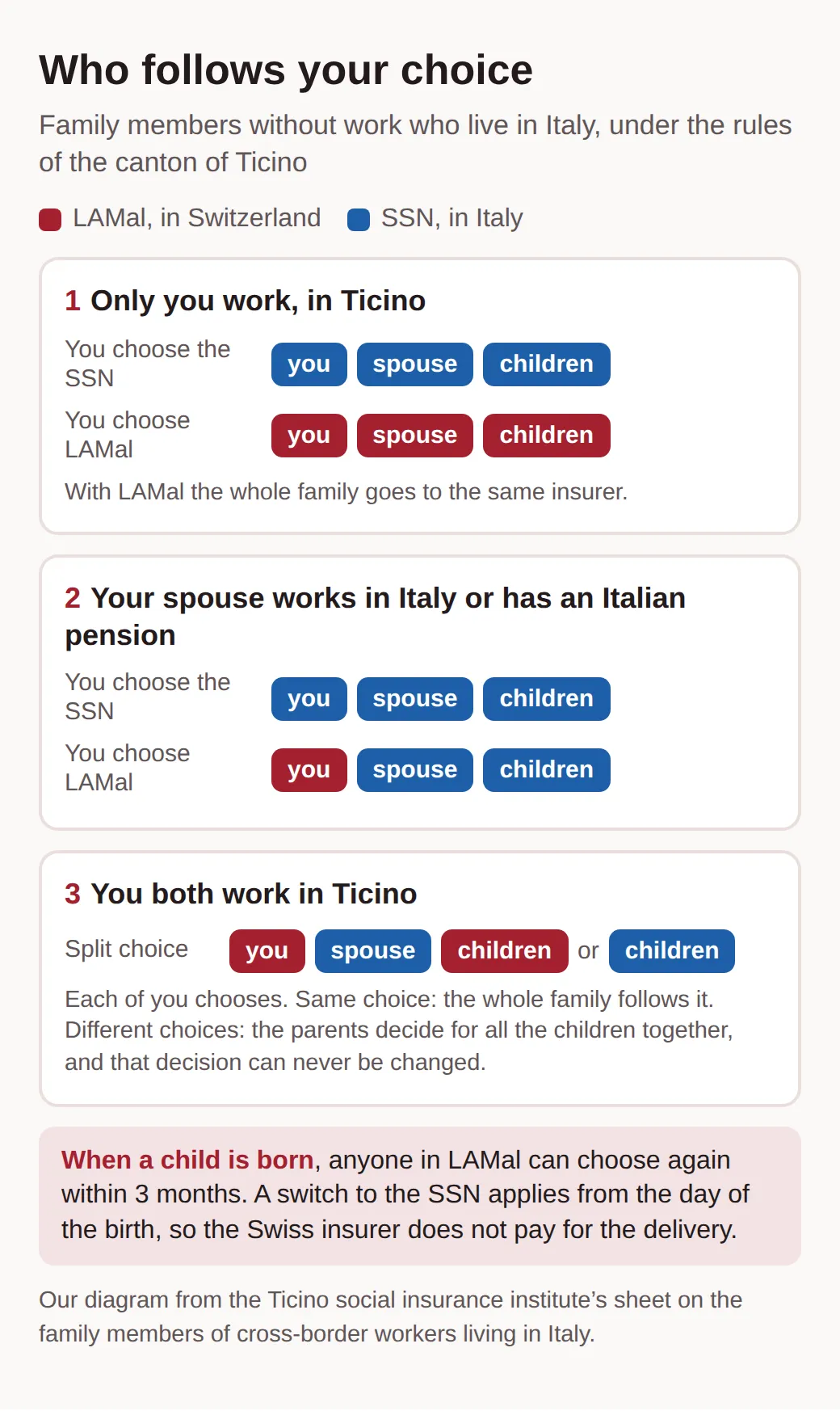
The third case is couples who both work in Ticino. Each of you exercises your own option: if you both choose the SSN, the family stays in Italy; if you both choose LAMal, the children go with one parent's insurer. If one of you chooses Switzerland and the other Italy, you decide together where to insure the children, all of them at once: you can't have one child in Switzerland and another in Italy. And the canton warns that this choice for the children can't be changed later.
The birth of a child and the cost of the delivery
When a child is born, if you're in LAMal you can exercise the option again, within three months of the birth. It looks like a handy way out, but the canton points to a side effect that's easy to miss. If you choose the SSN, the switch applies from the day of the birth: the Swiss insurer ends the contract the day before, and so, the IAS writes, it won't cover any costs of the delivery.
In practice, a couple in LAMal who are expecting a child have to decide before the birth where it will take place and who pays for it. The canton advises settling this in advance with the Italian local health authority (azienda sanitaria). If you stay in LAMal after the birth instead, the child's premium is added to the bill: CHF 70.60 to 203.70 a month in 2027, depending on the insurer.
Before your first day at work
The choice between LAMal and the SSN is best prepared before you sign, not after. On cost alone, the 2027 figures favour the SSN for a new cross-border worker: no premium per person, and the contribution in the 2024 Budget Law is aimed at old cross-border workers. In our view LAMal makes sense mainly if you want treatment in Switzerland with Swiss insurance and you've budgeted for the premium of every family member. Either way, it pays to run the numbers for your own family, with your insurer's premium and, if you're an old cross-border worker already in the SSN, with the rate your region decides.
Then three simple steps. On your first day at work, put the three-month deadline in your diary. Within the first few weeks, send your exemption request to Bellinzona or choose a LAMal insurer, without waiting for your permit. And if you're expecting a child, talk to the local health authority before the birth, not after. It takes a few minutes, and it can save you years of premiums or a hospital bill nobody wants to pay.
Common questions
- Can I switch from the SSN to Swiss health insurance after a few years?
- As a rule, no. The Federal Office of Public Health has reminded insurers and cantons that anyone exempted through a formal application cannot go back to being insured in Switzerland. Before you count on a switch, after a move for example, ask the Contributions Office in Bellinzona to confirm it in writing.
- Do self-employed cross-border workers have the right to choose?
- Yes. The Common Institution under the KVG lists cross-border workers living in Germany, France, Italy and Austria who are employed or self-employed in Switzerland among those who can choose. The same three-month deadline and the same proof of cover in Italy apply.
- Where do I apply for the exemption if I work in Graubünden or Valais?
- To the municipality. In the list of responsible offices updated in September 2026, Graubünden and Valais leave exemption requests to the municipality of residence or stay, or, for cross-border workers, the municipality where they work. Ticino, by contrast, handles them all at the Contributions Office in Bellinzona.
- Do cross-border workers insured under LAMal pay Italy's health tax?
- No. Italy's 2024 Budget Law provides for it for old cross-border workers who opted for the SSN and for their dependent family members. If you're in LAMal you already pay the Swiss premium, and new cross-border workers don't belong to that group.
- Can cross-border workers get a subsidy on their LAMal premium?
- Yes, if they're on a low income. The Federal Office of Public Health says that for cross-border workers the canton where they work is responsible, so for a job in Ticino that means the cantonal social insurance institute. Who qualifies and how much they get are set by the canton's rules.
More posts
All posts
Ticino B permit: requirements, fees and G permit compared
B permit in Ticino for EU citizens: who qualifies, applying and fees at the Migration Office, tax and health insurance as a resident, the C after 5 years.

Cross-border family allowances: who pays what in 2026
Family allowances for cross-border workers in Ticino: when INPS pays first, what Switzerland adds, how to apply and how many years of arrears you can claim.

Swiss pension for cross-border workers: AVS, LPP, Italy's 5%
Cross-border workers living in Italy: what your AVS pension is worth, where to claim it, LPP annuity or lump sum, Italy's 5% tax and the Swiss tax refund.