Swiss pension for cross-border workers: AVS, LPP, Italy's 5%

Before you retire
If you worked in Ticino as a cross-border worker, you get your AVS pension even while living in Italy, from the month after you reach the reference age: 65 for men. Your second pillar pays out as a pension or as a lump sum. Italy taxes both at a flat 5%, not through Irpef, and Switzerland refunds what it withholds on a lump sum if you claim within three years.
The costly questions come next. What is an AVS pension worth after 15 or 25 years as a cross-border worker rather than 44? Where do you send the claim? What does INPS, Italy's national social security institute, add up? And why does your pension fund withhold a tax on the lump sum that you can then get back? The answers sit in the rules of the Swiss Compensation Office, INPS, Italy's tax agency (Agenzia delle Entrate) and the Canton of Ticino, and we follow them in the order the money arrives.
Three funds, no transfers
A cross-border worker reaches retirement with two or three funds, and each pays its own share. The AVS, Switzerland's state pension and the first pillar (OASI in official English, AHV in German), is paid to people living abroad by the Swiss Compensation Office (SCO) in Geneva. The second pillar, occupational pensions under the LPP, is paid by your employer's pension fund, or by the bank or insurer holding your vested benefits. Years worked in Italy, before or after your time across the border, stay with INPS.
The money doesn't move from one fund to another. INPS says so in its page on aggregating insurance periods (totalizzazione, in Italian): adding up periods with Switzerland doesn't transfer any contributions, it only helps you qualify for a pension. Nor can you get your AVS contributions back: the Swiss Compensation Office rules out a refund for EU and EFTA nationals.
The good news is that Switzerland sets a low minimum. According to AVS leaflet 3.01, one full year of contributions is enough to be entitled to an old-age pension. So even if you worked in Ticino for just one year, you've already earned something. How much depends on how many years.
How much is a cross-border worker's AVS pension?
In 2026 a full AVS pension is between CHF 1,260 and CHF 2,520 a month, depending on your average income over your career. Full means without gaps: contributions every year from 1 January after your 20th birthday to 31 December before the reference age, in practice 44 years. With fewer years you get a partial pension, and leaflet 3.01 states that each missing year normally cuts it by at least one forty-fourth.
That's the rule that matters most for cross-border workers, because few spend their whole career in Ticino. The chart shows the resulting estimate for five typical careers.
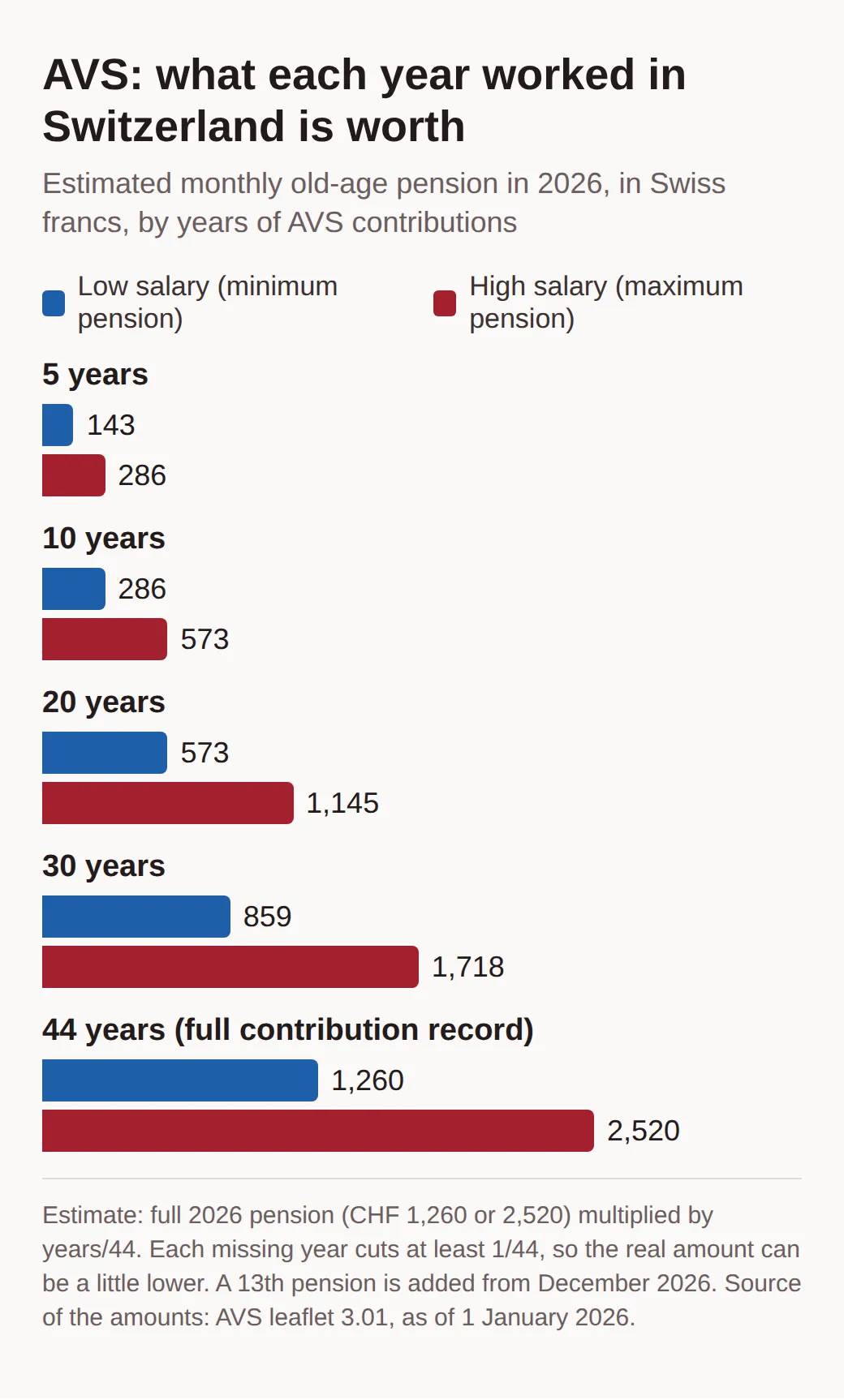
So twenty years as a cross-border worker on a good salary are worth at most about CHF 1,145 a month, and ten years about 573. The real calculation is done by the Swiss Compensation Office on your individual account, and it can come out a little lower, because the cut is at least one forty-fourth per missing year. Married couples also face a cap: the two pensions together can't exceed CHF 3,780 a month.
From December 2026 there's also a 13th pension. Leaflet 3.01 describes it like this: anyone entitled to an old-age pension in December receives an extra twelfth of the annual pension, paid with the December pension. The leaflet makes no exception for people living abroad. Survivors', disability and children's pensions are still paid twelve times a year.
Drawing it early or late
The reference age is 65 for men. For women it rises in steps: 64 and 6 months if you were born in 1962, 64 and 9 months for 1963, and 65 from 1964 on. You can draw the pension one or two years early, from 63, or from 62 for women born between 1961 and 1969. The price is high and lasts for life: according to leaflet 3.04, one year early cuts the pension by 6.8% and two years by 13.6%. Women in the transitional generation get more favourable rates.
If instead you defer the pension by one to five years, it goes up by 5.2% to 31.5%. The Swiss Compensation Office's page on old-age pensions points out that you must ask to defer within one year of reaching the reference age.
Working in Ticino after 65
If you keep working in Switzerland after the reference age, you still pay AVS contributions, either on your whole salary or with the first CHF 1,400 a month exempt. In return, the same page explains, those contributions can fill gaps and raise your pension up to the maximum, through a recalculation you can request only once. For anyone with a short career in Ticino, it's one of the few ways to add years.
That leaves the practical step: where to send the claim.
Where to claim your AVS pension: INPS or Geneva
It all comes down to one question: have you ever paid contributions in Italy? The Swiss Compensation Office explains it on its page for EU nationals living outside Switzerland.
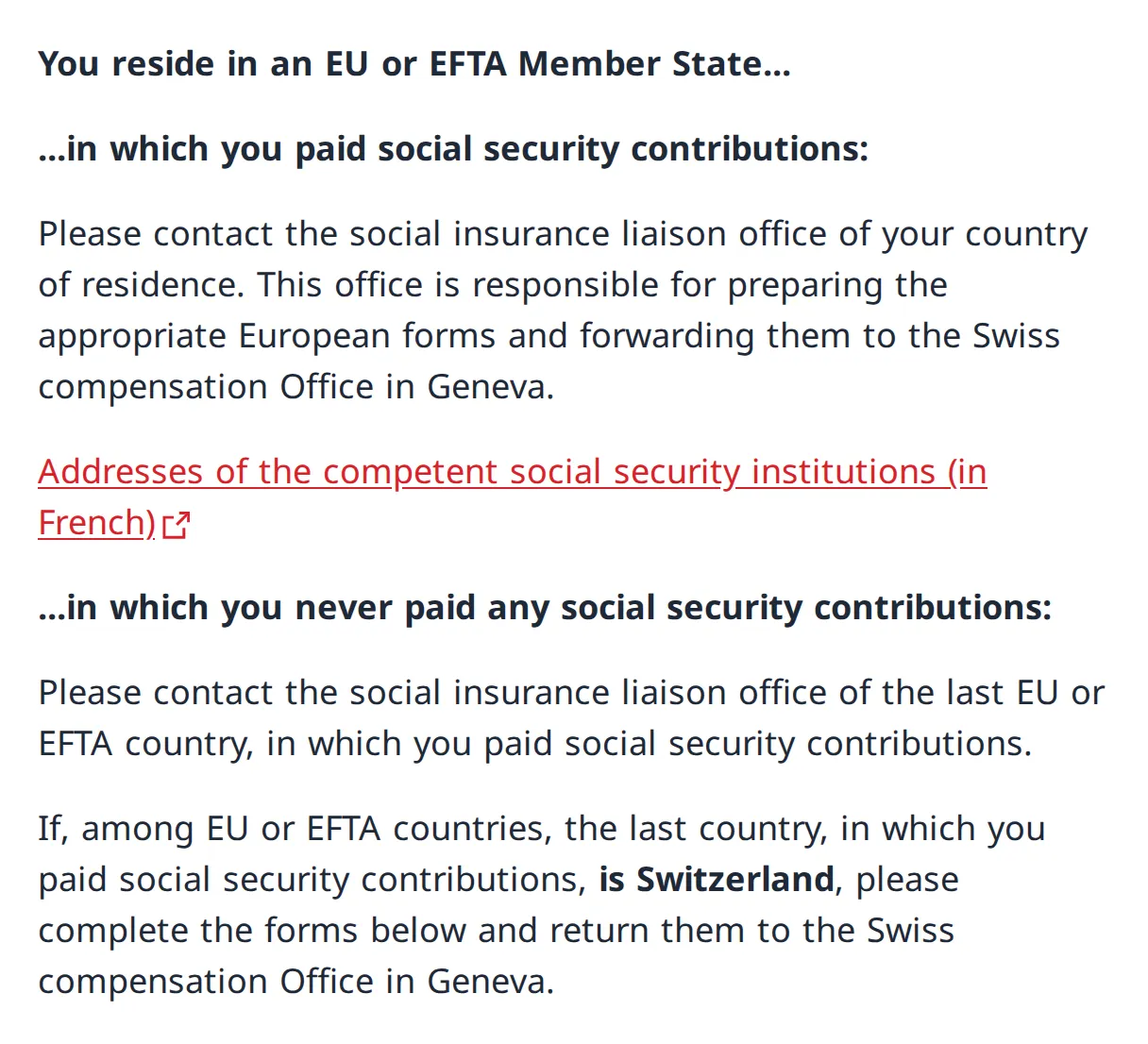
If you also have INPS years, you file a single claim in Italy. INPS, in its page on claiming a pension under EU rules (in Italian), says that people living in Italy who are insured with INPS and also have periods in Switzerland must claim through INPS: online with SPID, CIE or CNS (Italy's digital identity systems), through the contact centre or through a patronato, one of Italy's social security advice offices. Leaflet 3.01 confirms this from the Swiss side: a claim filed in your country of residence starts the procedure in every country involved.
If you only ever worked in Ticino, you write directly to Geneva, with form 318.000.1, the "Application for an old-age pension for persons residing outside Switzerland", and form E207, which lists the countries where you worked. Form 318.000.1 also asks for your IBAN and your periods of work in Switzerland, employer by employer. Leaflet 3.01 advises applying three to four months before the reference age, and an early pension can't start retroactively.
Before that, it pays to check your record. The individual account statement is free: you request it online through the office's eCdC eService with a copy of your ID, and processing can take up to two months. It shows the income recorded year by year, so an employer who never paid your contributions turns up there, not when you're 65. For an estimate of your future pension, the office offers the ESCAL calculator or a pension forecast on request. Your Italian years, on the other hand, are for INPS to work out.
Aggregation with INPS: what it adds up and what it doesn't
Aggregation helps you qualify for an Italian pension, not make it bigger. For the old-age pension (pensione di vecchiaia), INPS requires you to be 67 in 2026 and to have at least 20 years of contributions, as its page on the old-age pension (in Italian) explains. The age goes up to 67 and one month in 2027 and to 67 and three months in 2028, under INPS circular 28 of 2026 (in Italian). If your first contribution was paid in 1996 or later, your pension must also be at least as high as Italy's social allowance (assegno sociale), or you wait until 71.
Your years in Ticino help you clear the 20-year bar. To count them, though, you need at least 52 weeks of contributions in Italy: the INPS page on aggregation sets the minimum at one year in the country that grants the pension. After that, each country pays for itself, in proportion to its own years. This is the pro rata pension.
Take a made-up but common career: 12 years as an employee in Italy, then 25 in Ticino. On its own, INPS wouldn't reach 20 years; with aggregation it does, and it pays a pension worked out on the 12 Italian years. The AVS pays its partial pension for the 25 Swiss years, but two years sooner: from 65, while INPS starts at 67 or later. For two years or more, that person lives on the Swiss pension alone, and that's where the second pillar becomes decisive.
Your second pillar at retirement: pension or lump sum
By law, the second pillar is paid as a pension. Article 37 of the LPP (in Italian) does, however, give every insured person the right to take a quarter of their mandatory retirement savings as a lump sum, and lets the fund's regulations offer it all as capital. The same article lets the fund set a deadline for the request: decide too late and you can lose the choice. If you're married, you need your spouse's written consent.
The fund sets the age within the legal limits. Article 13 of the LPP ties the reference age to the AVS one and allows early retirement from 63 and deferral up to 70, while the regulations may set a lower age. If you live in Italy, there are no special restrictions on drawing it at retirement: the LOB Guarantee Fund (LOB is the English abbreviation for the LPP) states that a lump sum taken as a retirement benefit is paid without any check on your insurance situation abroad.
If you choose the pension, you normally receive it without any Swiss deduction. Ticino's directive on tax at source (in Italian) provides for 10% on pensions paid abroad, but not where the double taxation agreement gives the right to tax to the country of residence. That's the case for Italy: the fund pays the pension in full and checks your residence from time to time with an Italian tax certificate. On a lump sum, though, the deduction always applies, and we come to it below.
If you leave your job in Ticino before retirement
Here the rule changes, and many cross-border workers find out late. When you stop working in Switzerland you can ask for your vested benefits in cash, but Article 25f of the Vested Benefits Act (in Italian) excludes the mandatory part for as long as you're compulsorily insured in an EU country. In plain terms: if you go back to work in Italy, and so pay into INPS, you can only withdraw the extra-mandatory part. The mandatory part stays in Switzerland in a vested benefits account or policy.
The check goes through the LOB Guarantee Fund, which passes the request on to INPS. The Fund's information sheet for Italy (in Italian) adds a practical detail: if you don't say where the blocked savings should go, once the legal deadline has passed your pension fund sends them to the Substitute Occupational Benefit Institution in Zurich. Vested benefits can be withdrawn no earlier than five years before the AVS reference age. If you lose your job before retirement, you'll find the NASpI rules in our article on unemployment for cross-border workers.
Italy's 5%: what it covers and how you pay it
In Italy, AVS and LPP benefits fall outside Irpef, the Italian income tax. Article 76 of Italian Law 413 of 1991 subjects them to a 5% tax, and the paragraphs added in 2017 and 2023 extended it to the second pillar "in any form" (in qualunque forma) and to payments that don't come through an Italian bank. Only Italy has the right to tax them: Article 18 of the double taxation agreement between Switzerland and Italy (in Italian) gives pensions for past employment to the country of residence alone.
How you pay depends on the account. If your AVS pension arrives in an Italian account, the bank withholds the 5% as withholding agent, and the law says you no longer have to declare that pension. If it arrives in a Swiss account, you work out the 5% yourself. Ruling no. 125 of 2024 from the Agenzia delle Entrate (in Italian) explains how: in quadro RM, sezione V of the Redditi PF tax return, with code "I" and country code 071, paying with an F24 form and tax code 1242. You declare the gross amount received during the year.
The same ruling settles two common questions. The 5% applies to the whole LPP lump sum, mandatory and extra-mandatory parts alike, and also to voluntary buy-ins made to increase the pension. And in the case it examined, it also applied to savings paid out of two vested benefits accounts. The law also covers benefits from Swiss early retirement schemes.
From 1 January 2027 the article number changes, not the rule. From that date, Legislative Decree 33 of 2025, the consolidated act on tax payments and collection, applies: it repeals Article 76 and carries its rule over, 5% included, into Article 37. The Agenzia already warns in ruling no. 125 that the instructions for the tax return forms may change, so check them again for your 2027 tax return.
The exception for public sector pensions
One group falls outside the 5%. Article 19 of the agreement reserves to Switzerland the pensions paid by the Confederation, a canton, a municipality or certain public bodies to Swiss citizens. The Federal Tax Administration's overview of the agreements applies the same rule to dual citizens. A cross-border worker with only an Italian passport who worked for the canton, on the other hand, falls under the general rule. If you also hold Swiss citizenship, have your case checked before you choose the lump sum.
Swiss tax at source on the lump sum, and how to get it back
When you take the lump sum, your pension fund withholds tax at source, even though the agreement gives Italy the right to tax it. Ticino's directive is explicit: if you have no residence in Switzerland when the money is paid, you pay tax at source, even if it goes into a Swiss account. It's withheld by the canton where the fund is based, not the one where you worked. Nothing is withheld below CHF 1,000.
With a Ticino fund, the canton's latest VIC table (the tax at source table for lump sums, in Italian), valid from 1 January 2025, sets CHF 4,117.50 on 100,000 and CHF 6,795 on 150,000 for a single person. For other taxpayers the figures are slightly lower. The diagram follows CHF 150,000 from payout to refund.
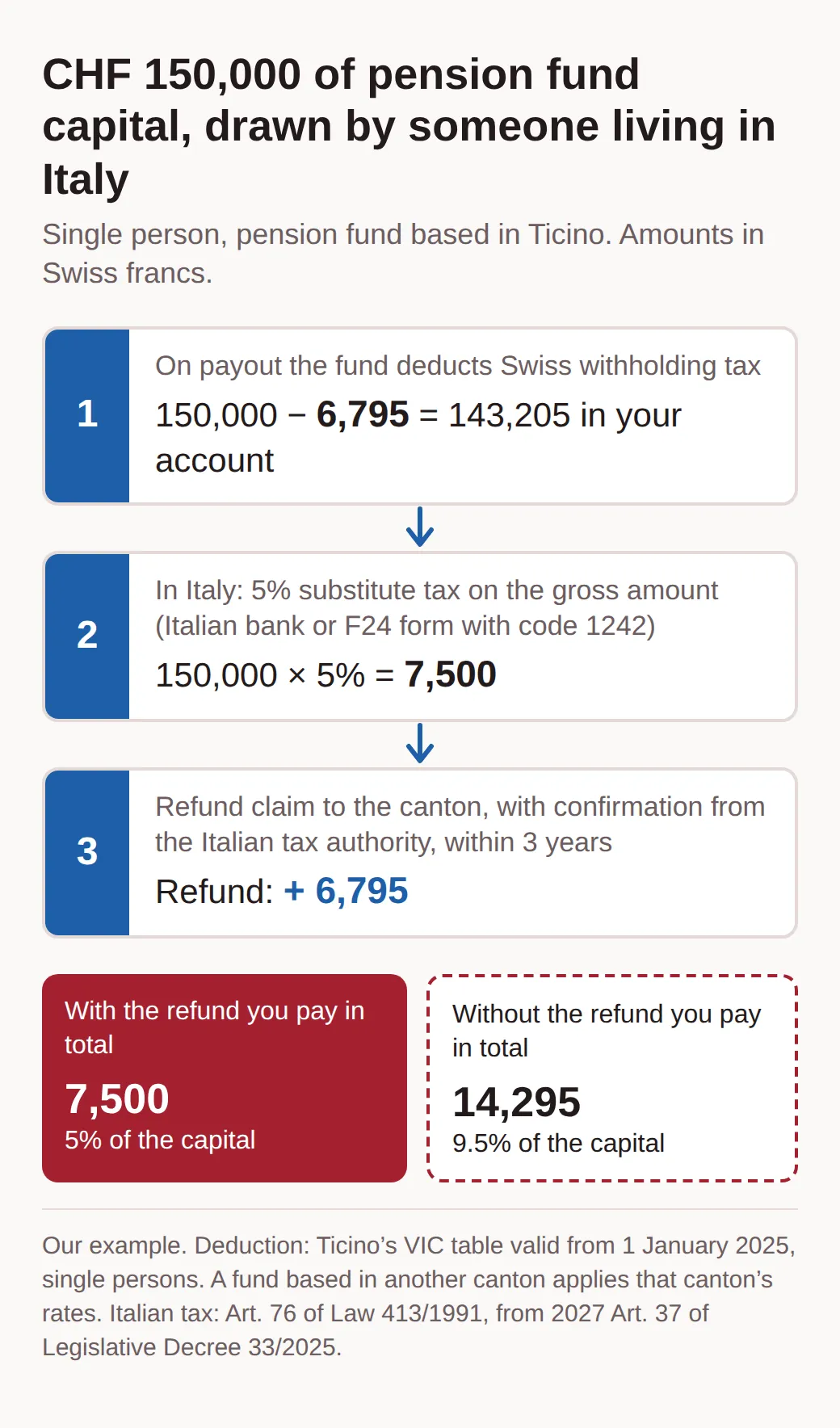
The refund isn't automatic. The Federal Tax Administration (FTA), in its notice on benefits from private-law pension funds (in French), states that the tax is refunded in full, without interest, on the official form with a certificate from the tax authority of your country of residence. The refund form asks one extra thing for Italy compared with other countries: the tax authority must certify that it has actually taxed the payment, with proof enclosed. In practice you need proof of the 5% paid, meaning the bank's deduction or the F24, and the Agenzia delle Entrate's stamp on the form.
The deadline is three years from the payout of the capital, and the claim goes to the canton where the fund is based, with a copy of the payout statement. The form warns that processing can take up to three months and that nothing happens until the fund has settled the tax with the canton. If you pay the 5% with the following year's tax return, you have time, but not a lot: a late tax return, or a stamp requested at the last minute, can cost you the entire Swiss deduction.
What to do in the years before you retire
The useful work happens at 55 or 60, not at 64. Request your AVS account statement and check that every year you worked across the border is there, with the right income. Ask your pension fund how much of your savings is mandatory, what its regulations allow for a lump sum and the deadline for telling the fund your choice. If you have years in Italy, check with INPS or a patronato that you have at least 52 weeks of Italian contributions and when aggregation will get you to 20 years.
Then decide where the money should land. An Italian account makes the 5% on the pension automatic; a Swiss account leaves it to your tax return. If you take the lump sum, put the refund claim in your diary on the day it's paid. And if you retire with a Swiss pension, look at your health insurance too, because your first retirement reopens a choice we explain in the article on health insurance for cross-border workers. For the tax on your salary in the years you have left, the figures are in the article on cross-border workers' taxes.
Common questions
- Can I get my AVS contributions back when I stop working in Ticino?
- No, not if you're a citizen of Italy or another EU or EFTA country. The Swiss Compensation Office only refunds contributions to nationals of countries without a social security agreement and of a handful of listed countries. Your contributions stay in Switzerland and become a pension at the reference age, even if you only worked there for one year.
- Can I pay voluntary AVS contributions from Italy to fill the gaps?
- No. Voluntary AVS is open to Swiss, EU and EFTA nationals who move outside the EU and EFTA after at least five consecutive years of compulsory insurance. If you live in Italy, you don't qualify. The only way to add years is to keep working in Switzerland.
- Are retired cross-border workers living in Italy entitled to AVS supplementary benefits?
- No. AVS leaflet 3.01 says it plainly: people who live abroad are not entitled to supplementary benefits. If your partial pension is small, find out early about Italian benefits, which follow INPS rules.
- Can I use my Swiss pension fund money to buy a home in Italy?
- The LOB Guarantee Fund states that the restrictions for people living in the EU don't affect early withdrawals to buy a home. The conditions, though, are set by Swiss law and your pension fund's regulations. Before you sign a preliminary sale contract, ask the fund in writing whether a property in Italy qualifies and which documents it wants.
More posts
All posts
Ticino B permit: requirements, fees and G permit compared
B permit in Ticino for EU citizens: who qualifies, applying and fees at the Migration Office, tax and health insurance as a resident, the C after 5 years.

Cross-border family allowances: who pays what in 2026
Family allowances for cross-border workers in Ticino: when INPS pays first, what Switzerland adds, how to apply and how many years of arrears you can claim.
Cross-border workers' health insurance: LAMal or SSN in 2027
Live in Italy and work in Ticino? You have three months to choose LAMal or the SSN. 2027 premiums, Italy's health tax, family rules and the cost of a birth.